
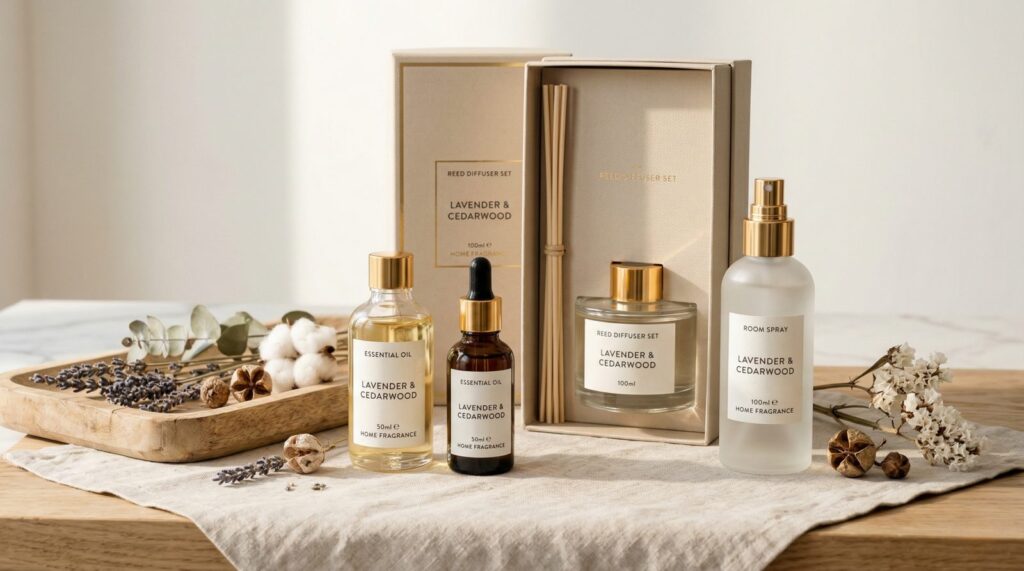
The fastest way to enter the fragrance market isn’t to build a product from scratch — it’s to put your brand on one that already works. That’s exactly what private label aroma products make possible.
You choose the product format, define the packaging and branding, and a manufacturer handles everything else. The result is a product that looks and feels like your own line — because it is.
This guide walks through the five steps that actually matter, plus what most buyers get wrong on their first order.
What Private Label Aroma Products Actually Means
Private labeling means sourcing a manufacturer’s existing product and selling it under your own brand name, logo, and packaging. You’re not formulating from zero — you’re selecting from proven formats, customizing the presentation, and bringing it to your market.
For aroma products specifically, this typically covers:
- Aroma diffusers — your logo on an existing hardware model, sometimes with custom color options
- Fragrance oils — stock scents decanted into your branded bottles with your label
- Reed diffusers — stock or lightly customized formulas in your chosen vessel and packaging
- Room sprays — fragrance oil blended to your brief, filled into branded spray bottles
Each format has different MOQ requirements and lead times, which affects which one makes sense as a starting point.
Private Label Aroma Products: 5 Steps From Brief to First Shipment
Step 1: Choose Your Product Format
Before anything else, decide what you’re actually selling. The format determines everything downstream — supplier type, MOQ, price point, shipping logistics, and customer experience.
Ask yourself:
- Is this for retail (gift shops, boutiques, spas) or commercial use (hotels, offices)?
- Do you want a passive product (reed diffuser) or an active one (electric diffuser)?
- What price point are you targeting at retail?
If you’re launching your first private label line, fragrance oils or reed diffusers are the most forgiving starting point — lower MOQ, simpler logistics, and easier to test without large capital commitment.
Step 2: Define Your Brand Identity Before Contacting Anyone
Most first-time buyers contact suppliers before they know what they want. This wastes time on both sides.
Before reaching out, prepare:
- Brand name and logo (even a draft version)
- Target color palette for packaging
- 3–5 scent directions you’re interested in (e.g., “woody and warm,” “fresh citrus,” “floral and feminine”)
- Intended sales channel (online, retail stores, hospitality)
- Approximate budget per unit at retail
A supplier who receives a clear brief will respond with useful options. One who receives “I want to start a fragrance brand” will send you a generic catalog.
Step 3: Find a Supplier Who Works at Your Scale
The private label aroma products market in China ranges from factories with 50,000-unit minimums to smaller operations that work with boutique brands from 100–300 units per SKU.
What to look for:
- Experience with export — they understand labeling regulations, packaging standards, and shipping documentation for your market
- Sample availability — a supplier who won’t provide samples for a fee isn’t the right partner
- Formula documentation — for fragrance oils especially, you want batch records and the ability to reorder the exact same product 12 months later
- Clear communication — response time and clarity of answers tells you more than any catalog
Step 4: Confirm Packaging, MOQ, and Lead Time in Writing
Once you’ve identified a shortlist of suppliers and received samples you’re happy with, get the following confirmed before placing any order:
- MOQ per SKU (and what happens if you want to reorder at lower volume)
- Packaging customization options — which elements can be changed (label, box, bottle color) and which can’t
- Lead time from order confirmation to shipment
- Labeling requirements for your target market (EU, US, and GCC have different rules)
- Payment terms
Don’t skip this step. Assumptions here are the most common source of first-order problems.
Step 5: Start With a Sample Order, Not a Full Run
Even after approving pre-production samples, request a small first batch — typically 10–20% of your intended volume — before committing to a full production run.
This lets you verify:
- Color and finish match the approved sample
- Fragrance strength and throw match your expectation in real conditions
- Packaging integrity after shipping (boxes, bottles, pumps)
- Label print quality
A supplier confident in their quality won’t object to a phased first order. One who pressures you to skip sampling is telling you something.
What Separates a Good Private Label Partner From a Generic Supplier
The difference rarely shows up in the product catalog. It shows up in:
- How quickly they respond when something goes wrong
- Whether they keep records that let you reorder consistently
- Whether they proactively flag issues (lead times, ingredient availability) before they become your problem
- Whether they understand your end market, not just their production process
For private label aroma products specifically, you want a partner who has done this before with international buyers — not someone running their first export order alongside yours.
Common Mistakes on the First Private Label Order
Skipping the scent brief. Telling a supplier “I want something nice” leads to generic results. Bring reference products or describe the emotion you want the scent to create.
Over-customizing on the first order. Custom bottle molds, custom pump mechanisms, and fully custom formulations all add cost and MOQ. Start with stock formats and customize the label and packaging first.
Ignoring labeling regulations. Fragrance products sold in the EU require IFRA compliance documentation and ingredient disclosure. The US has its own requirements. Confirm your supplier can provide the documentation your market requires.
Ordering by price alone. The cheapest fragrance oil is often the one that fades in two weeks or smells nothing like the sample. In a category where the product is the experience, quality consistency matters more than unit cost.
At Scentvita, we work with buyers at every stage of private labeling — from choosing the right format for a first launch to scaling an established brand into new product lines. If you’re figuring out where to start, the fastest way forward is a direct conversation.
Talk to us about your project →
Related reading:
- Fragrance Oil Wholesale MOQ: 5 Things Buyers Must Know
- How to Source Aroma Diffusers from China: A Practical B2B Guide
External reference: IFRA fragrance standards for cosmetic and home products