
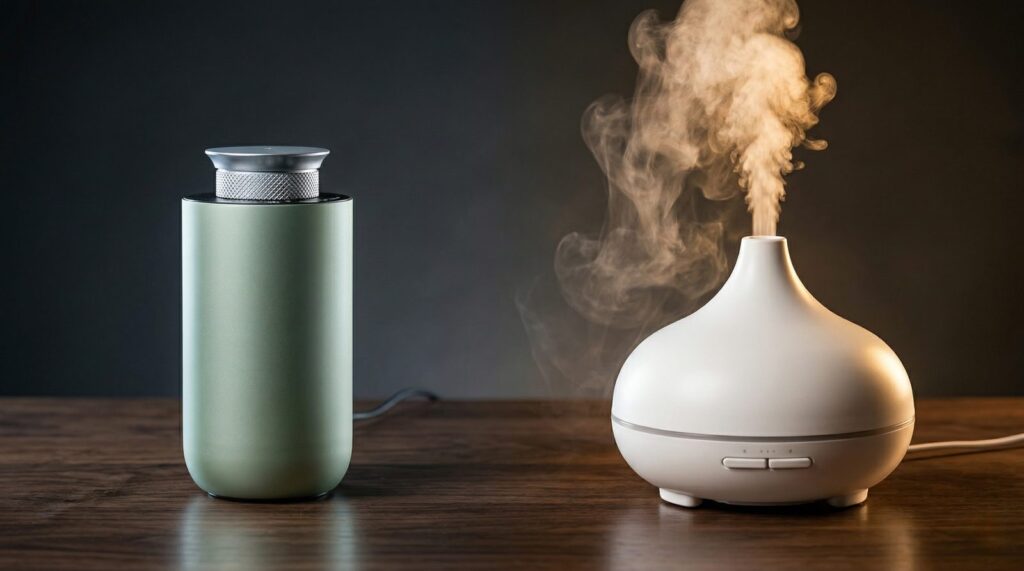
When you start researching aroma diffusers for a commercial space, the cold air diffuser vs ultrasonic question comes up fast — and the answers you find online are usually written by people trying to sell you one or the other.
This guide gives you a straight comparison. Both technologies work. Both have genuine advantages. Which one is right depends on your space, your volume requirements, and what you’re actually trying to achieve with scent.
Cold Air Diffuser vs Ultrasonic: How They Work
Understanding the technology gap makes every other difference easier to follow.
A cold air diffuser (also called a nebulizing diffuser) uses a high-pressure air pump to break fragrance oil into micro-particles and push them into the air. No heat. No water. Just oil and air. The output is a dry, ultra-fine mist that stays suspended in the air longer than any other diffusion method.
An ultrasonic diffuser uses high-frequency vibrations to agitate a mixture of water and fragrance oil, creating a visible water vapour mist. The fragrance is carried on water droplets, which are heavier than nebulized oil particles and settle faster.
That fundamental difference in how each system handles the oil drives every practical distinction below.
5 Key Differences for Business Buyers
1. Scent Quality and Oil Integrity
This is where cold air diffusers have a clear, measurable advantage.
Heat and water both alter fragrance oil chemistry. Ultrasonic diffusers don’t use heat (unlike older steam diffusers), but the water dilution changes how the scent profile presents — top notes tend to dominate, middle and base notes underperform.
Cold air diffusion pushes undiluted oil directly into the air. The scent you smell is the scent in the bottle — true to the original formulation, with all notes present. For businesses using premium or custom fragrance oils, this matters.
Verdict: Cold air wins on scent fidelity. Ultrasonic is acceptable for standard applications where exact scent profile is less critical.
2. Coverage Capacity
Commercial spaces need real coverage — not the 30m² that most consumer-grade ultrasonic units deliver.
Cold air diffusers scale to commercial requirements. A mid-range cold air unit covers 200–600m². High-output models reach 800–3,000m². HVAC-integrated cold air systems can scent an entire building from a single unit.
Ultrasonic diffusers top out at around 50–100m² for a quality consumer unit. Commercial ultrasonic units exist but require multiple units running simultaneously to cover large areas — which creates noise, maintenance, and refill-frequency issues.
Verdict: Cold air for any space over 100m². Ultrasonic for small offices, treatment rooms, or residential applications.
3. Maintenance Requirements
Ultrasonic diffusers require regular cleaning. Water sitting in the reservoir breeds bacteria and mould if not maintained, and mineral deposits from tap water clog the vibrating membrane over time. In a hotel or commercial setting, that means staff training and a maintenance schedule.
Cold air diffusers have no water reservoir to clean. The oil runs directly through the system. The main maintenance tasks are occasional nozzle cleaning and oil refills. High-quality units can run for months between service interventions.
Verdict: Cold air wins on maintenance load. Important for hospitality and commercial settings where staff time is limited.
4. Humidity and Environment Impact
Ultrasonic diffusers add moisture to the air. In a dry environment (winter, air-conditioned spaces), this can be pleasant. In an already-humid environment — a spa changing room, a coastal property, a kitchen-adjacent space — it creates problems: condensation, mould risk, and a clammy atmosphere.
Cold air diffusers add no moisture. They work identically at any humidity level and in any climate.
Verdict: Cold air is the only safe choice for humid environments. Ultrasonic requires humidity awareness.
5. Unit Cost and Fragrance Oil Consumption
Ultrasonic diffusers are cheaper to buy. A quality commercial ultrasonic unit starts around $30–80. A cold air diffuser at equivalent output starts around $80–200. High-output cold air commercial units run $200–600+.
However, cold air diffusers use undiluted oil — no water. Oil consumption is higher per hour than an ultrasonic unit running diluted oil. For buyers comparing running costs, the relevant calculation is cost-per-m³-covered, not cost-per-ml-consumed.
Over a 12-month period in a commercial space, the total cost difference between the two technologies is smaller than the unit price gap suggests.
Verdict: Ultrasonic wins on upfront cost. Cold air is more cost-efficient at scale when coverage requirements are high.
Which Format Suits Which Business?
| Business Type | Recommended Format |
|---|---|
| Hotel lobby (200m³+) | Cold air — wall or floor-standing |
| Hotel guest room | Either — ultrasonic adequate at this scale |
| Spa treatment room | Cold air — no humidity, quiet operation |
| Retail boutique (<100m²) | Either |
| Office open plan (100m³+) | Cold air |
| Restaurant / bar | Cold air — no moisture near food |
| Gym / fitness | Cold air — humid environment |
| HVAC-integrated system | Cold air only |
What to Check Before Placing a Commercial Order
Whichever format you choose, confirm the following before ordering:
- Noise level — specify ≤38 dB for any room where guests or staff need quiet
- Oil compatibility — some cold air units require specific viscosity ranges; confirm your fragrance oil works with the hardware
- Coverage rating methodology — suppliers measure coverage differently; ask whether the rating assumes doors open or closed, ceiling height, and ventilation
- Refill access — how easy is it to refill in situ? Units requiring disassembly create staff friction
- Warranty and spare parts — what happens when a pump fails on a unit running 12 hours a day?
At Scentvita, we supply both cold air and ultrasonic diffusers across the commercial range — from compact desktop units to high-output wall systems covering 3,000m³. If you’re working out which format fits your specific space and budget, we’ll give you a direct recommendation, not a catalog.
Get in touch with your requirements →
Related reading:
- Best Scents for Hotels: 5 Proven Choices That Work
- Reed Diffuser vs Electric Diffuser: 5 Honest Facts for Retailers
- How to Source Aroma Diffusers from China: A Practical B2B Guide
External reference: Nebulization vs ultrasonic diffusion — fragrance industry overview, Fragrantica