
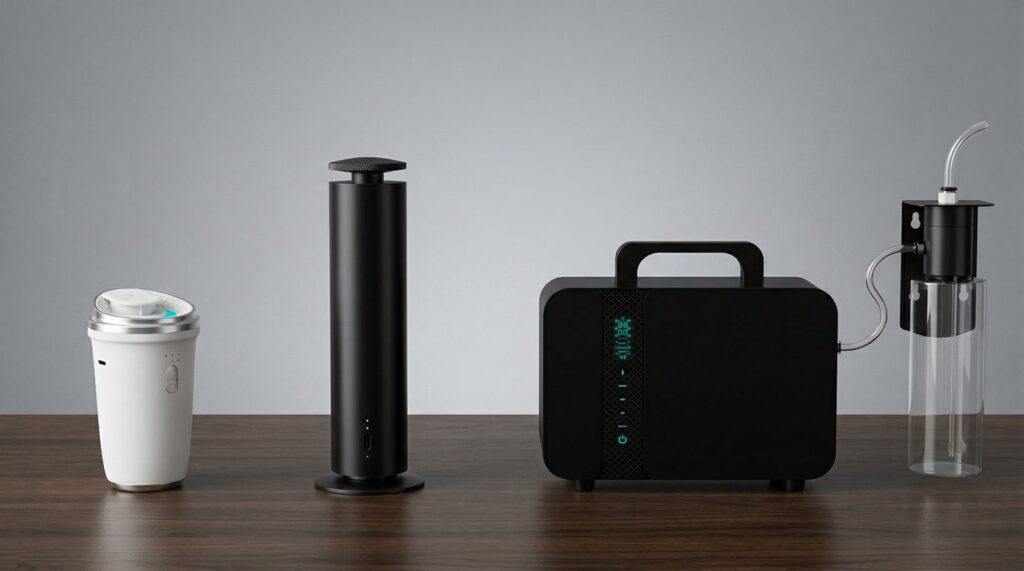
When buyers ask about aroma diffuser wholesale price, they usually get one of two responses: a vague “it depends” or a number with no context. Neither is useful.
Price does depend on several variables — but they’re not mysterious. Once you understand what drives cost, you can evaluate quotes more accurately, negotiate more effectively, and avoid paying a premium for something that doesn’t affect your end product.
Here are the five factors that actually move the number.
1. Diffusion Technology
This is the biggest single driver of aroma diffuser wholesale price. The technology inside the unit determines the component cost, the manufacturing complexity, and the price floor.
Ultrasonic diffusers use a vibrating membrane to create mist from water and oil. The components are widely manufactured, which keeps cost down. Wholesale prices typically range from $8–$35 per unit at volume, depending on size and features.
Cold air / nebulizing diffusers use a precision air pump to atomise undiluted oil. The pump mechanism is more complex and the tolerances tighter. Wholesale prices run $25–$120+ for desktop models, higher for commercial wall units.
HVAC-integrated systems involve additional hardware for duct connection and remote control. These are priced as commercial systems, not consumer units — typically $150–$600+ per unit wholesale.
If two quotes are far apart, the first question is whether they’re quoting the same technology. Often they’re not.
2. Coverage Capacity and Output
Larger coverage requires more powerful components — a bigger pump, a larger oil reservoir, a stronger fan if applicable. This drives cost proportionally.
As a rough benchmark:
- Under 100m³: $8–$40 wholesale
- 100–500m³: $30–$120 wholesale
- 500m³+: $80–$400+ wholesale
The jump from 100m³ to 500m³ isn’t just a bigger box — it’s a fundamentally different pump, different housing, often different electronics. Expect price to scale accordingly.
3. MOQ and Order Volume
Aroma diffuser wholesale price drops significantly with volume. This isn’t negotiating leverage — it’s structural. Smaller runs require more production changeovers, more packaging adjustments, and proportionally higher overhead per unit.
Typical price bands from Chinese manufacturers:
| Order Quantity | Price vs. Base |
|---|---|
| 50–100 units | +30–50% |
| 200–500 units | Base price |
| 1,000+ units | −10–20% |
| 5,000+ units | −20–35% |
If you’re comparing wholesale price across suppliers, always compare at the same quantity. A quote for 100 units and a quote for 1,000 units are not comparable numbers.
4. Customization Scope
Stock units — the model as the factory already makes it — are the cheapest option. Any customization adds cost, and the amount depends on what you’re changing.
Low cost impact:
- Logo laser engraving or UV sticker
- Custom colour from existing options
- Fragrance oil selection
Medium cost impact:
- Custom packaging (sleeve, box print at 200–500+ units)
- Custom fragrance formulation
- Firmware or app integration changes
High cost impact:
- New colour requiring separate production run
- Modified components (buttons, nozzle, reservoir)
- Private mold / custom shape (see separate article)
A common mistake is requesting customizations without asking which ones are absorbed into standard pricing and which trigger added cost. Ask specifically: “What’s included in your quoted price, and what costs extra?”
5. Supplier Type and Supply Chain Position
Where a supplier sits in the supply chain affects their price floor.
Direct factories have the lowest unit cost but often higher MOQs, less flexibility on small runs, and less experience with export documentation and international buyer requirements.
Trading companies and brand owners sit one step from the factory. Unit cost is slightly higher, but MOQs are often lower, communication is easier, and they typically handle export compliance, certifications, and logistics coordination.
For most B2B buyers outside China — especially those placing mixed orders across multiple SKUs — the total cost of working with a direct factory (time, errors, logistics) often exceeds the per-unit price difference.
The right question isn’t “who has the lowest unit price” — it’s “who gives me the best landed cost with the least friction.”
What You Can and Can’t Negotiate
Negotiable:
- Unit price at higher MOQ commitment
- Payment terms (deposit %, balance timing)
- Packaging inclusions
- Sample cost (often refundable against first order)
Not meaningfully negotiable:
- Technology cost (a cold air unit cannot be priced like an ultrasonic)
- Certification costs (CE, FCC, RoHS are real costs, not padding)
- Shipping and logistics (driven by weight, volume, destination)
Pushing too hard on unit price with a legitimate supplier usually results in one of two outcomes: they decline, or they find a way to reduce quality to meet your number. Neither serves your business.
Getting a Quote That’s Actually Comparable
To get accurate quotes from multiple suppliers, specify:
- Diffusion technology (ultrasonic / cold air / nebulizing)
- Coverage requirement (m² or m³)
- Quantity (be specific — quotes vary significantly)
- Customization requirements (logo, colour, packaging)
- Destination port (affects whether price is EXW, FOB, or DDP)
- Certification requirements for your market
A supplier who responds with a clear, itemised quote to these specifications is telling you something about how they operate.
At Scentvita, we give straightforward pricing based on what you actually need — not the lowest number to win the conversation. If you’re comparing options or want a baseline for your category, we’re easy to reach.
Request a wholesale price quote →
Related reading:
- How to Source Aroma Diffusers from China: A Practical B2B Guide
- Cold Air Diffuser vs Ultrasonic: 5 Honest Differences for Business Buyers
- Total Landed Cost: 5 Hidden Risks When Importing Aroma Diffusers from China
External reference: Wholesale trade — Wikipedia