
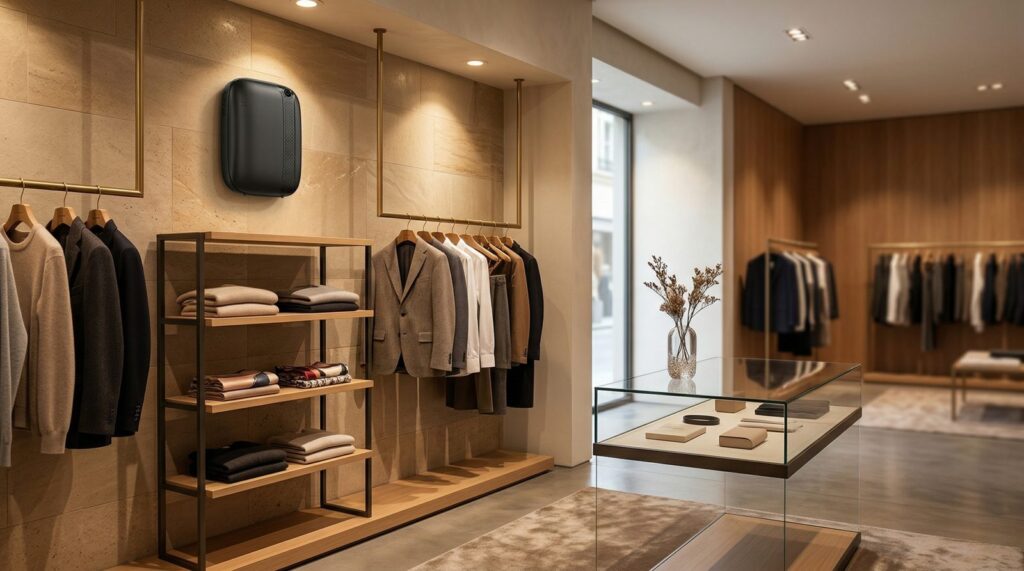
Of all the senses, smell is the one most retail stores completely ignore — and the one with the most documented effect on buyer behaviour.
Scent marketing for retail isn’t a gimmick. It’s a measurable tool used by some of the world’s best-performing stores, from luxury boutiques to hotel gift shops to supermarket chains. This guide explains what the research actually shows, which scents work in which environments, and what a practical implementation looks like without a large budget.
What Scent Marketing for Retail Actually Means
Scent marketing is the deliberate use of fragrance to influence how customers feel, behave, and remember a space. In retail, the goal is usually one or more of the following:
- Keep customers in the store longer
- Create a positive emotional association with the brand
- Increase the perceived value of products
- Differentiate the space from competitors
It doesn’t require a signature custom fragrance or an expensive system. A well-chosen stock scent, consistently applied, achieves most of these goals at a fraction of what stores spend on visual merchandising.
Scent Marketing for Retail: 5 Ways It Affects Buyer Behaviour
1. Dwell Time
This is the most consistently replicated finding in retail scent research. When a pleasant, congruent scent is present, shoppers stay longer.
A study published in the Journal of Retailing found that ambient scent increased time spent in a store by 15–20%. More time in-store correlates directly with more items considered and higher average transaction value — without any change to the product range or pricing.
The scent doesn’t need to be remarkable. It needs to be present, pleasant, and consistent with the store’s identity.
2. Purchase Intent
Scent activates the limbic system — the part of the brain that governs emotion and memory — more directly than any other sensory input. This creates a positive emotional state that makes customers more open to purchasing.
Research from Washington State University found that simple ambient scenting increased consumer spending by up to 20% in certain retail categories. The effect is strongest when the scent is congruent with what’s being sold — a warm vanilla in a bakery, a fresh linen scent in a linen store, a woody amber in a menswear boutique.
3. Brand Recall
Scent memory is remarkably durable. Studies show people can recall a scent-associated memory with 65% accuracy after a year — compared to 50% for visual memories after three months.
For retail brands trying to build repeat footfall, a consistent store scent becomes part of the brand identity. Customers who associate a particular fragrance with a positive shopping experience are more likely to return and more likely to recommend the store.
4. Perceived Product Value
The ambient environment affects how customers evaluate individual products. In a scented space that feels premium, products are perceived as higher quality and worth more — even when the products themselves are identical.
This is particularly relevant for gift retail, wellness products, and any category where brand positioning commands a price premium. The scent is part of the story you’re telling.
5. Staff Environment
This one is rarely mentioned in scent marketing discussions, but it matters. Staff spend 8 hours a day in the store environment. A well-chosen scent — particularly fresh or citrus-forward profiles in areas where staff work — has documented effects on alertness, mood, and error rates.
For high-turnover retail environments, this is a meaningful operational benefit beyond the customer-facing impact.
Choosing the Right Scent for Your Store
The most common mistake in retail scent marketing is choosing a fragrance based on personal preference rather than customer psychology.
A few principles that hold across categories:
Match the scent to the product and customer. A children’s clothing store and a men’s leather goods store need completely different fragrance profiles. The scent should feel like it belongs — not imposed.
Avoid polarising notes. Heavy florals, strong musks, and aggressive spice profiles create strong reactions — positive for some, very negative for others. In a retail environment where you can’t control who walks in, softer, cleaner profiles are generally safer.
Lighter is better. Shoppers should notice a pleasant atmosphere, not identify a specific scent. If customers comment on “that smell in the shop,” it’s probably too strong. The goal is mood, not fragrance experience.
Category recommendations:
- Boutique clothing / lifestyle: warm woods, soft amber, white tea
- Gift and home décor: light florals, linen, fig
- Wellness and beauty: green tea, eucalyptus, clean citrus
- Food-adjacent retail: vanilla, cinnamon (appetite-stimulating, use carefully)
- Luxury / jewellery: oud, sandalwood, leather
Which Diffuser Format Works for Retail?
For most retail spaces under 200m², a plug-in or wall-mounted cold air diffuser is the practical choice. It runs quietly, requires minimal maintenance, and delivers consistent output without adding humidity — which matters in spaces where fabrics or paper goods are on display.
For larger retail floors or open-plan spaces, a higher-output cold air unit (200–600m² coverage) positioned near the entrance or ventilation flow covers the space efficiently.
Ultrasonic diffusers work for smaller spaces but add water vapour — a consideration in fashion retail, bookshops, or anywhere moisture-sensitive products are displayed.
What to Budget For
Scent marketing for retail doesn’t require a large upfront commitment.
A practical starting setup:
- Hardware: one wall-mounted or plug-in diffuser, $40–$150 depending on coverage
- Fragrance oil: 100–500ml of a stock scent, $15–$60 depending on volume
- Running cost: most units consume 1–3ml of oil per hour at normal intensity
For a 100m² store running 10 hours a day, monthly oil consumption is typically 300–600ml. At wholesale fragrance prices, that’s $10–$30 per month in consumables — less than most stores spend on window cleaning.
The ROI calculation is simple: if scent marketing increases average transaction value by 5–10% and you’re already confident in your product range and pricing, the hardware pays for itself within weeks.
If you’re considering scent marketing for a retail space — whether a single store or a multi-location rollout — we can recommend the right hardware and fragrance profile for your specific setup.
Talk to us about your retail scent brief →
Related reading:
- Best Scents for Hotels: 5 Proven Choices That Work
- Cold Air Diffuser vs Ultrasonic: 5 Honest Differences for Business Buyers
- Aroma Diffuser Wholesale Price: 5 Real Cost Factors
External reference: Olfaction and consumer behaviour — Wikipedia