
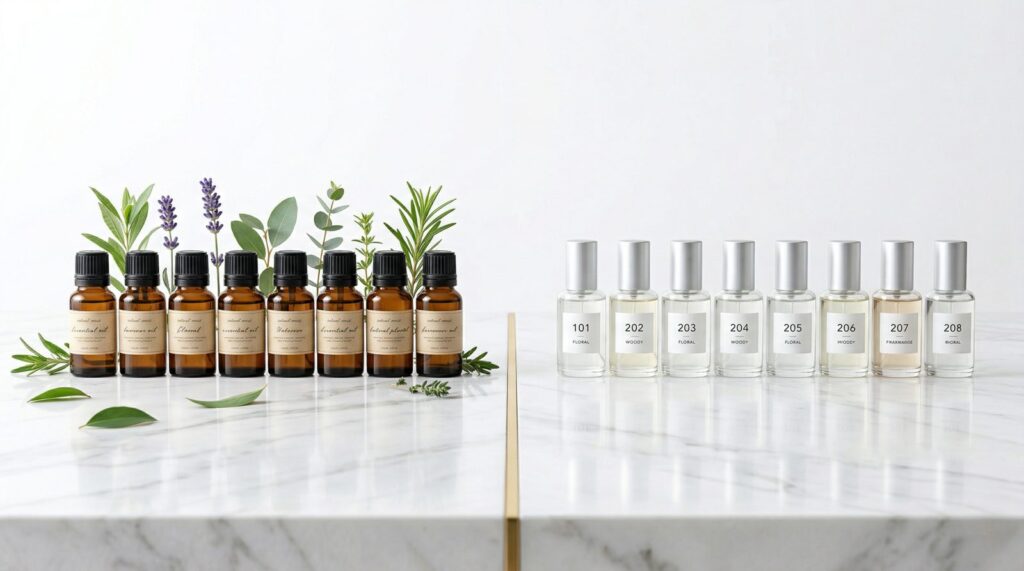
The fragrance oil vs essential oil question comes up in almost every conversation with buyers who are new to sourcing scent products. Both go into diffusers. Both produce scent. But they’re fundamentally different products — and for most commercial applications, they’re not interchangeable.
This guide explains the practical differences from a buyer’s perspective, not a chemistry textbook.
The Core Difference
Essential oils are extracted directly from plants — through steam distillation, cold pressing, or solvent extraction. The result is a concentrated, natural aromatic compound. Rose essential oil comes from rose petals. Eucalyptus oil comes from eucalyptus leaves. The price reflects how much raw plant material went in.
Fragrance oils are engineered aroma compounds — typically a blend of natural and synthetic aromatic molecules formulated to produce a specific scent profile. They may contain some natural-derived ingredients, but the final product is designed in a lab to achieve consistency, performance, and cost efficiency.
Neither is inherently better. They serve different purposes.
Fragrance Oil vs Essential Oil: 5 Differences That Matter for Business
1. Scent Consistency Across Batches
This is where fragrance oils have a clear commercial advantage.
Essential oils are agricultural products. The scent of lavender essential oil varies by harvest year, growing region, and weather conditions — just like wine. If you’re building a brand around a consistent sensory experience, batch-to-batch variation in essential oil is a real operational problem.
Fragrance oils are formulated to spec. Once a formula is approved and documented, a competent manufacturer can reproduce it identically across batches, seasons, and years. For hotels, retail chains, or any business where scent consistency is part of the brand promise, this matters enormously.
2. Cost and MOQ
Essential oils range from affordable (citrus, eucalyptus, peppermint) to extremely expensive (rose, neroli, jasmine absolute). High-quality rose essential oil can cost $500–$2,000+ per kilogram wholesale — because it takes several tonnes of rose petals to produce one kilogram of oil.
Fragrance oils that smell identical to rose, jasmine, or neroli cost a fraction of that. For commercial diffusion — where the oil is being consumed continuously across a large space — the economics of essential oil simply don’t work for most applications.
MOQ also differs. Premium essential oils in smaller quantities are accessible, but the cost per hour of diffusion becomes impractical at commercial scale. Fragrance oils are designed for volume use.
3. Regulatory Compliance
Both essential oils and fragrance oils used in scent products for commercial sale need to meet safety standards. In the EU, IFRA (International Fragrance Association) guidelines govern what aromatic compounds can be used and at what concentrations. Reputable fragrance oil suppliers formulate to these standards and provide documentation.
Essential oils, being natural, are sometimes assumed to be automatically safe — but this isn’t accurate. Many essential oils contain compounds that are restricted or prohibited in certain applications or concentrations under IFRA guidelines. Phototoxic compounds in citrus oils, for example, are regulated.
For buyers importing into markets with formal compliance requirements, the documentation trail for fragrance oils from professional suppliers is typically more straightforward than for essential oil blends.
4. Scent Range and Customization
Essential oils are limited to what plants produce. You can blend them, but you’re working within the constraints of nature.
Fragrance oils cover the full spectrum — including scents that have no natural source. Ocean breeze, fresh linen, rain on concrete, baked goods, specific flower profiles that don’t exist as standalone essential oils. For commercial environments where the scent needs to evoke a specific emotion or atmosphere, fragrance oils offer far more creative range.
Custom fragrance oil development — where a perfumer formulates a signature blend to your brief — is also standard practice. The same process with essential oils is possible but significantly more expensive.
5. Performance in Commercial Diffusers
Most commercial cold air and nebulizing diffusers are optimised for fragrance oil viscosity. They’re designed to atomise a specific type of oil consistently over hours of operation.
Some essential oils — particularly thick resinous ones like vetiver, patchouli, or sandalwood — can clog the atomizer nozzle in cold air diffusers over time. Fragrance oils formulated for diffuser use are viscosity-controlled to work within the hardware’s specifications.
If you’re sourcing hardware and oil from different suppliers, confirm the oil viscosity is compatible with your diffuser model. A hardware supplier should be able to tell you the acceptable range.
Which Should You Use for Commercial Diffusion?
For most commercial applications — hotels, retail, offices, spas, restaurants — fragrance oils are the practical choice. Consistent scent output, predictable cost, wide range of profiles, and straightforward compliance documentation.
Essential oils have a strong case in:
- Wellness applications where “100% natural” is a genuine product claim and marketing asset
- Aromatherapy contexts where the therapeutic properties of specific plant compounds matter
- Premium retail products where the natural sourcing story justifies the price to end consumers
In a cold air diffuser running 10 hours a day in a hotel lobby, essential oil doesn’t perform better than a well-formulated fragrance oil — it just costs more.
A Note on “Natural” Claims
The fragrance industry has clear definitions for what can be marketed as natural, nature-identical, or synthetic. Buyers building consumer products with scent claims should understand what their supplier’s oil actually contains before putting claims on packaging.
A reputable fragrance oil supplier will provide full ingredient documentation, IFRA compliance certificates, and Safety Data Sheets. If a supplier can’t provide these, that tells you something about how seriously they take the product.
At Scentvita, we supply fragrance oils across 147+ scent profiles — all formulated for commercial diffuser use and available with full compliance documentation. If you’re evaluating options for a specific application, we can recommend the right profile and concentration.
Ask us about fragrance oil options →
Related reading:
- Fragrance Oil Wholesale MOQ: 5 Things Buyers Must Know
- Best Scents for Hotels: 5 Proven Choices That Work
- Scent Marketing for Retail: 5 Ways It Actually Works
External reference: Essential oil — Wikipedia