
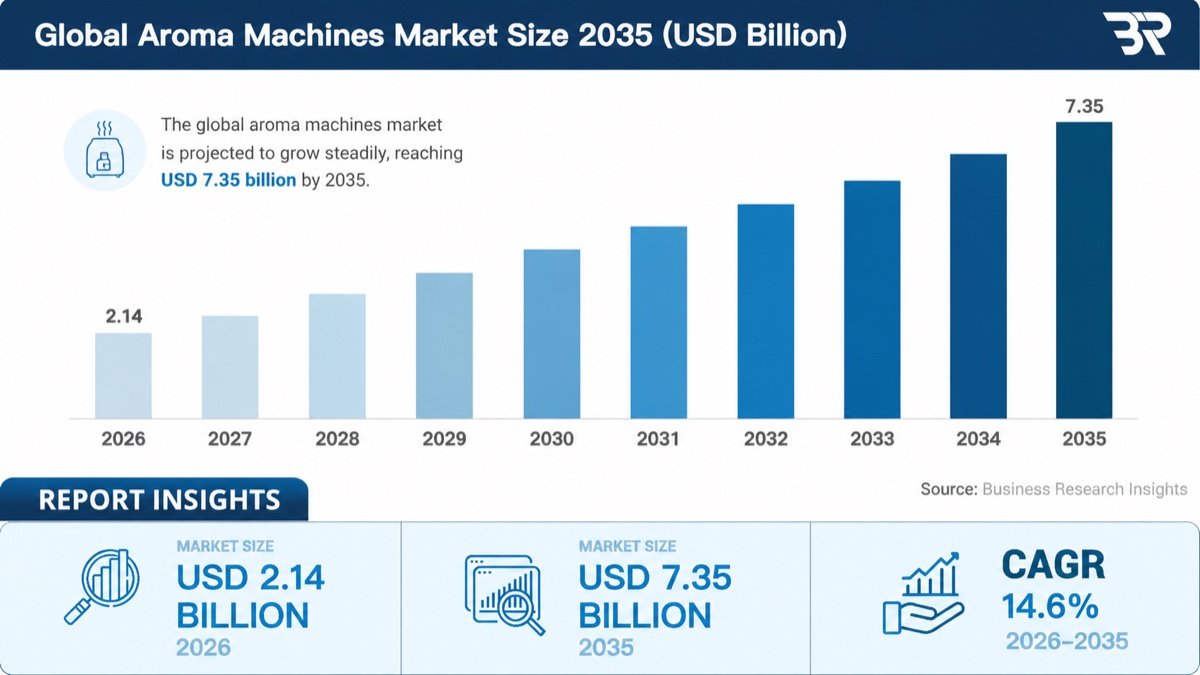
The aroma diffuser market is expanding faster than most buyers realize. Global market size is projected to grow from $2.14 billion in 2026 to $7.35 billion by 2035 — a compound annual growth rate of 14.6%, according to Business Research Insights. For hotel groups, retailers, and facility managers sourcing diffusion equipment, that growth curve has direct implications for pricing, product availability, and competitive positioning.
Why the Aroma Diffuser Market Is Growing at 14.6% CAGR
The numbers reflect something buyers are seeing on the ground: scent is becoming standard, not optional, in commercial environments.
- 72% of hotel brands now use scent diffusion systems
- 65% of retail stores have adopted them
- 58% of office environments deploy them
- 66% of U.S. consumers link a specific scent to brand recall
- 61% of users report improved customer experience from aroma diffusion
These aren’t fringe numbers. They represent mainstream adoption across the venues most likely to purchase commercial-grade equipment. The psychology of scent and brand memory is well documented — the market growth reflects buyers acting on it at scale.
5 Market Trends That Matter for Buyers
1. Small machines dominate, but large-space hardware is catching up
Small aroma machines covering 100–1,000 sq ft hold 62% of the market. Large and medium machines for 2,000–10,000 sq ft account for the remaining 38% — but this segment is growing faster as commercial properties scale deployment from single rooms to full-floor and HVAC-integrated installations.
For buyers: the product range for large-space diffusion is broader and more competitive than it was three years ago, and prices are coming down as volume increases.
2. Cold air diffusion is becoming the commercial standard
54% of commercial aroma machines now use cold air diffusion technology. This shift reflects a growing understanding that cold air systems preserve fragrance integrity better than ultrasonic or heat-based alternatives — particularly relevant for premium fragrance oil blends where scent profile consistency matters across shifts and seasons. For a practical breakdown of the difference, see our guide on cold air diffusers vs ultrasonic.
3. IoT and app control are now expected features
63% of new commercial diffusers include IoT integration. 57% support mobile app control. AI-based scheduling is used in 48% of new manufacturer offerings.
For multi-site operators, this matters: centralized scent scheduling across locations used to require on-site adjustment. It increasingly doesn’t. If you’re specifying hardware for a chain deployment, IoT capability should be on your checklist by default.
4. Commercial applications drive the majority of demand
56% of aroma machine use is commercial — hotels, retail, offices. Residential accounts for 27%, automotive 17%. For B2B buyers, this confirms what you’re already experiencing: the commercial segment is where product specifications are becoming most exacting, and where the broadest range of hardware is available.
Hotel applications are particularly active. If you’re sourcing for hospitality, our breakdown of the best scents for hotel environments covers the fragrance side of the decision.
5. North America leads, but Asia-Pacific is accelerating
North America holds 38% of the global aroma diffuser market. Europe follows at 29%. Asia-Pacific accounts for 24% and is the fastest-growing region — driven by hospitality expansion and retail development. Shopping mall floor area in the region grew 22% from 2020 to 2024.
For buyers sourcing from Chinese manufacturers, this has a supply-side implication: factory capacity has scaled significantly to meet both domestic and export demand, which has generally improved lead times and product consistency compared to the 2021–2023 supply chain disruption period.
What’s Holding the Market Back — and What It Means for Buyers
Not every business is deploying scent systems. The constraints are real and worth knowing before you go to market:
- 46% of small businesses cite installation cost as the primary deterrent
- 39% of users report ongoing maintenance challenges
- 34% of enterprises face regulatory compliance concerns
- 28% of potential buyers are deterred by allergy and sensitivity concerns
The installation cost barrier is the most actionable for new buyers. The gap between entry-level and commercial-grade cold air systems is significant — but mid-tier commercial hardware capable of covering hotel corridors, retail floors, and mid-sized offices has become substantially more accessible in the $200–$800 per unit range.
The maintenance issue often comes down to fragrance oil quality. Consistent, correctly concentrated oil reduces diffuser clogging, extends service intervals, and maintains output reliability. Understanding fragrance oil MOQ and batch consistency before committing to a supplier reduces ongoing maintenance overhead significantly.
What This Means If You’re Sourcing Now
The aroma diffuser market trajectory is clear: adoption is accelerating, hardware is maturing, and the commercial segment is where investment is concentrating. Buyers entering the market now will find:
- A broader product range than existed two or three years ago
- Cold air technology increasingly available at mid-range price points
- IoT features becoming standard rather than premium add-ons
- More stable fragrance oil supply chains at commercial volumes
For businesses evaluating a first deployment or expanding an existing scent program, the conditions are favorable. If you’re assessing which hardware and fragrance oil combination fits your environment and volume requirements, contact Scentvita to discuss options.