
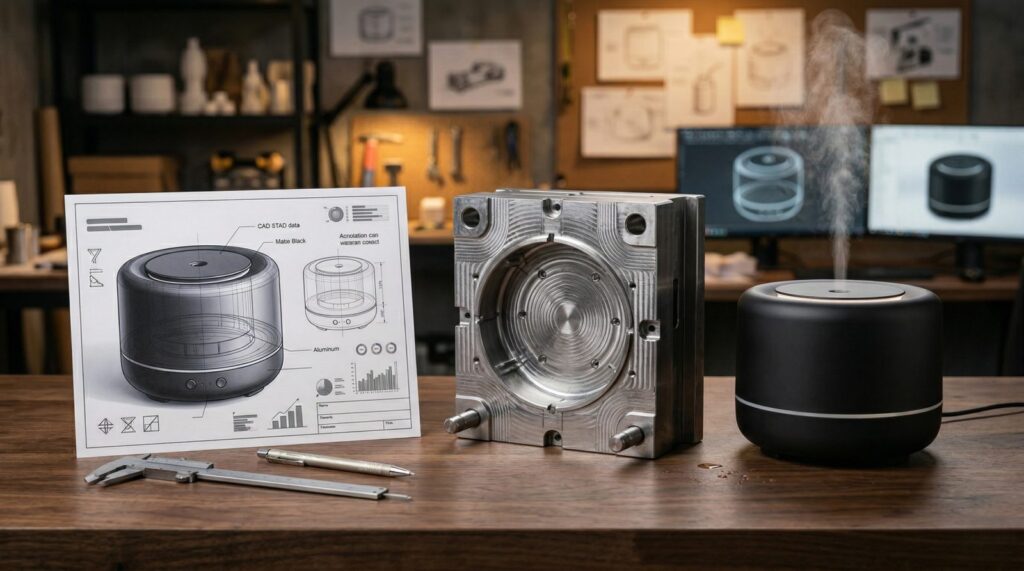
Every week, someone sends us a beautiful AI-rendered diffuser concept and asks: “Can you make this?”
The honest answer is usually: yes — but not in the way you’re imagining, not on the timeline you’re hoping for, and not at the budget most early-stage brands have set aside.
If you’re building a fragrance brand and you’re seriously considering an ODM aroma diffuser with a fully custom mold, this article will save you months of misaligned conversations with suppliers. Here’s what it actually involves.
What “ODM” and “Private Mold” Actually Mean
ODM stands for Original Design Manufacturing — you own the design, the manufacturer builds it to your spec. A private mold (or custom tooling) means the factory creates a physical mold specifically for your product shape, which only you can use.
This is different from OEM, where you put your branding on an existing product the factory already makes.
When clients ask for an ODM aroma diffuser, they typically want a shape that doesn’t exist yet — a specific silhouette, a sculptural form, a design that’s distinctly theirs. That’s a legitimate goal. But the path from concept to physical product is longer and more expensive than most people expect.
The Real Cost Breakdown
Mold Development
The mold itself is the first major cost — and it’s paid before a single unit is produced.
- Plastic injection mold: USD $50,000–$100,000+ depending on design complexity, number of components, and surface finish requirements. More complex shapes (undercuts, multiple parts, fine surface detail) push this higher.
- Metal mold (zinc alloy or aluminum die-cast): Lower MOQ than plastic, but higher per-unit cost. Better suited to premium products where material quality is a selling point.
One important note: a rendered image — whether it’s from a designer or AI-generated — is a starting point, not a technical brief. The factory’s engineering team needs to assess whether the design is manufacturable, and the final product will always have some variation from the original concept. Fillets, wall thickness, draft angles, assembly tolerances — these all shape what’s actually possible.
MOQ
Custom molds require volume to justify the tooling investment:
- Plastic mold: typically 2,000–5,000 units minimum per production run
- Metal mold: lower MOQ, but per-unit cost is higher
For context: a brand starting at 300 units per SKU is not at ODM scale yet.
Timeline
Mold development alone — from approved 3D files to first physical sample — takes 90–180 days. Factor in design revision rounds, sample approval, production scheduling, and shipping, and a full ODM aroma diffuser project from concept brief to product in your hands realistically takes 12–24 months.
Plastic Mold vs Metal Mold: Which Is Right?
| Plastic Injection Mold | Metal Die-Cast Mold | |
|---|---|---|
| Upfront tooling cost | Higher ($50K–$100K+) | Lower |
| Per-unit production cost | Lower at volume | Higher |
| MOQ | 2,000–5,000 pcs | 500–1,500 pcs |
| Best for | High-volume consumer brands | Premium/boutique positioning |
| Surface finish | Wide range, including soft-touch | Metal texture, premium feel |
| Timeline | 90–150 days | 60–120 days |
The choice isn’t purely about cost — it’s about what your brand positioning requires and whether your volume justifies the tooling investment.
Why ODM Projects Take So Long
This surprises most first-time buyers. The timeline isn’t padding — it reflects real steps that can’t be compressed:
- Engineering review — Can the design be manufactured? What needs to change?
- 3D modelling and technical drawings — From concept to production-ready files
- Mold fabrication — Physical machining, which takes weeks even for experienced toolmakers
- T1 sample — First physical sample from the mold, almost always requires adjustments
- Sample revision rounds — Multiple back-and-forth cycles on fit, finish, and function
- Pre-production approval — Final sign-off before mass production begins
- Production run — 30–60 days depending on volume
- QC and shipping
Skipping or rushing any of these steps is how brands end up with 3,000 units of something they can’t sell.
The Smarter Path for Early-Stage Brands
Here’s what experienced fragrance brand builders actually do at the beginning: they don’t start with a custom mold.
They start with an existing product base — a model the factory already makes, with proven engineering and no tooling risk — and they customise the elements that matter most to their brand:
- Custom logo on the unit
- Custom colour or surface finish (within available options)
- Custom fragrance oil formulated to their brief
- Custom packaging — box design, inserts, tissue, ribbon
This approach gets a market-ready product in 60–120 days, at MOQs as low as 50–300 units, for a fraction of what ODM tooling costs. More importantly, it lets you test whether your audience actually wants what you’re building before you’ve committed to a 2,000-unit production run of a design nobody has seen before.
The brands that eventually do private mold development successfully are almost always the ones who validated their concept first with existing hardware.
When Does Custom Mold Development Actually Make Sense?
A custom mold is the right move when:
- You have a proven product-market fit and need a shape that differentiates at scale
- Your volume projections justify the tooling investment (typically 5,000+ units per year)
- You have 12–18 months of runway before the product needs to generate revenue
- Your brand positioning makes the premium material or form factor a genuine selling point — not just a visual preference
If you’re not at that stage yet, an ODM aroma diffuser project is likely to slow you down, not accelerate you.
We work with brands at both stages — early-stage teams using existing hardware to get to market fast, and established brands ready to invest in proprietary design. If you’re trying to figure out which path fits where you are right now, the most useful thing is a direct conversation.
Tell us about your project → No pressure. We’ll give you a straight answer on what’s realistic.
Related reading:
- How to Private Label Aroma Products: 5 Steps to Your Own Brand
- Fragrance Oil Wholesale MOQ: 5 Things Buyers Must Know
- How to Source Aroma Diffusers from China: A Practical B2B Guide
External reference: What is ODM manufacturing — Wikipedia