
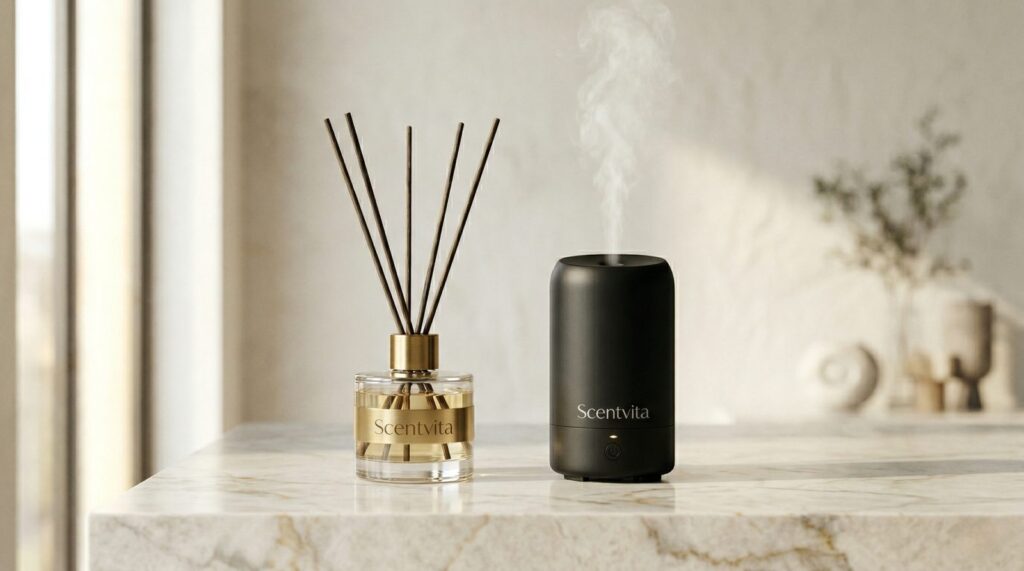
If you’re building out a fragrance product range, the reed diffuser vs electric diffuser decision comes up early — and it’s not as simple as “which one looks nicer.”
Both formats sell. Both have loyal customers. But they serve different buyers, carry different margins, and come with very different inventory risks. This guide breaks down the five most important differences so you can stock with confidence.
Reed Diffuser vs Electric Diffuser: What’s the Core Difference?
A reed diffuser is a passive system — fragrance oil sits in a glass vessel and evaporates naturally through rattan reeds. No power source, no moving parts, no maintenance beyond occasional reed flipping.
An electric diffuser (also called an aroma diffuser or nebulizing diffuser) uses cold-air, ultrasonic, or fan-based technology to actively disperse fragrance into a space. It requires power, has functional settings, and delivers noticeably stronger scent throw.
That fundamental difference in how they work drives every practical distinction below.
5 Key Differences for Retail and Wholesale Buyers
1. Price Point and Retail Margin
Reed diffusers sit in a lower price bracket — typically $15–$45 retail — with predictable COGS and straightforward packaging costs. Margins are solid if you’re sourcing well, usually 40–60% at retail.
Electric diffusers carry higher retail prices ($35–$150+) with stronger absolute margin per unit, but they also require more customer education at point of sale. Premium cold-air units for commercial use push into the $200+ range.
For retailers just entering the fragrance category: reed diffusers are lower risk per SKU and easier to bundle with refill oils for repeat business.
2. Customer Experience In-Store
The reed diffuser vs electric diffuser comparison becomes obvious the moment a customer picks it up. Reed diffusers are tactile, visual, and immediately understandable — no instruction needed.
Electric diffusers create a stronger impression when running in-store (a misting diffuser on a shelf is its own marketing), but require demonstration to convert. Customers who haven’t used one before often hesitate.
Implication: Electric diffusers perform better when you can demo them. Reed diffusers sell themselves on packaging and scent.
3. MOQ and Inventory Commitment
Reed diffusers generally come with lower MOQs because they’re simpler to produce — a glass vessel, fragrance oil, reeds, and a box. Most suppliers offer 50–200 units per SKU as an entry point.
Electric diffusers involve more components and more factory coordination. Expect MOQs of 100–500 units for standard models, higher if you want custom color or branding. Cold-air and commercial units often have stricter minimums due to component costs.
If you’re testing a new product line, reed diffusers let you validate scent preferences and packaging at lower volume before scaling.
4. Shelf Life and Inventory Risk
A reed diffuser has a practical shelf life of 12–18 months unopened, after which the fragrance oil may degrade. Electric diffusers don’t have this problem — the unit itself stores indefinitely, and fragrance oil refills are ordered separately.
This matters for retail inventory planning. A slow-moving reed diffuser SKU ties up capital in stock that has a countdown clock. An electric diffuser unit doesn’t spoil — though trend-driven designs can go stale.
5. Which Customer Buys Each
Understanding who actually buys each format helps you place them correctly.
Reed diffuser buyers tend to be:
- Gift purchasers (birthdays, housewarmings, holidays)
- Home décor customers who want a passive, always-on scent
- Spa and hotel guests looking for a take-home ritual product
Electric diffuser buyers tend to be:
- Home fragrance enthusiasts who want control over intensity
- B2B buyers (hospitality, retail chains, office spaces) looking for consistent coverage
- Customers upgrading from passive formats after experiencing a professional unit
Both overlap, but they’re rarely the same purchase decision.
Which Should You Stock First?
If you’re choosing between the two for a first order, the honest answer depends on your channel:
- Gift retail / boutique / spa retail → Start with reed diffusers. Lower MOQ, easier sell, natural upsell to refill oils.
- Hotel amenities / commercial supply → Electric diffusers. Coverage and consistency matter more than aesthetics.
- Online / DTC brand building → Both, but reed diffusers ship more easily and have fewer returns.
The reed diffuser vs electric diffuser choice doesn’t have to be either/or once you’ve validated your market.
A Note on Stocking Both
The brands that do well in fragrance retail usually carry both formats — positioned at different price points and for different occasions. Reed diffusers anchor the accessible end; electric diffusers anchor the premium or commercial end.
If you’re sourcing from a single supplier, this also simplifies logistics considerably. One supplier relationship, two product formats, consolidated shipments.
At Scentvita, we supply both reed diffusers and electric diffusers — from compact desktop units to large commercial systems — alongside fragrance oils that work across both formats. If you’re figuring out the right mix for your specific channel, we’re happy to talk through it.
Get in touch → No minimum inquiry. Just tell us what you’re building.
Related reading:
- How to Source Aroma Diffusers from China: A Practical B2B Guide
- Fragrance Oil Wholesale MOQ: 5 Things Buyers Must Know
External reference: How reed diffusers work — Wikipedia