
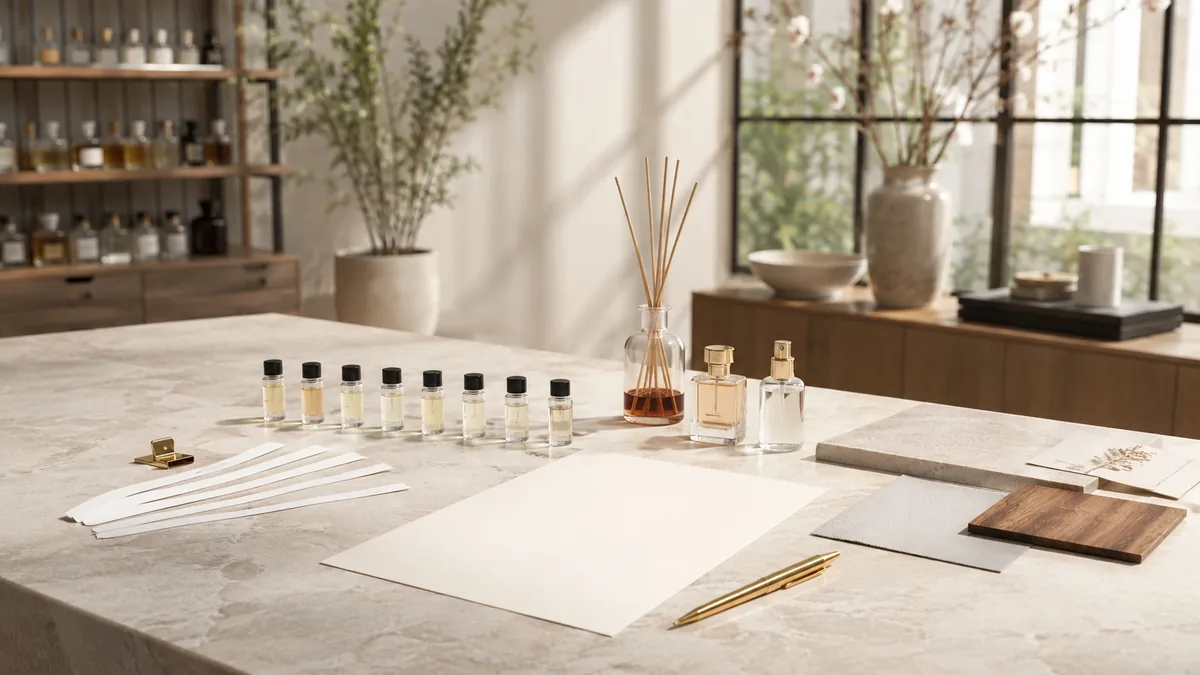
Yes, you can use the same fragrance in different products such as perfume, reed diffusers, room sprays, solid perfume and scented cards. But the same finished formula usually cannot be poured into every product without adjustment.
That distinction matters when developing private label fragrance products. The scent should remain recognisable across the range, while its carrier, concentration, application method, packaging and safety documentation may change.
In practical terms, aim for one consistent scent identity, not one universal liquid.
What “the same fragrance” should mean
When a brand asks for the same fragrance in different products, it usually wants customers to recognise a common identity. This can include the same fragrance name, family, key notes and emotional impression.
The finished products do not need to smell identical at every moment. Perfume develops on skin. A reed diffuser evaporates gradually into a room. A room spray gives an immediate burst in the air. A scented card releases fragrance from an absorbent material over time.
The goal is recognition, not perfect duplication.
Why one formula behaves differently in each product
Different delivery methods
Perfume is atomised onto skin or clothing. Reed diffusers draw liquid through reeds. Room sprays disperse droplets into the air. Solid perfume transfers a balm-like product to the skin. Scented cards hold fragrance in a porous substrate.
These methods affect which notes appear first, how far the fragrance travels and how long it remains noticeable.
Different bases
A fragrance concentrate must work with the selected carrier. Alcohol-based perfume, oil-based roll-ons, reed diffuser bases and room spray systems do not behave in the same way.
A formula that remains clear in one base may become cloudy in another. A scent that projects well from perfume may move too slowly through diffuser reeds. Application-specific samples should therefore be tested in the intended base.
Packaging affects performance
The bottle and closure are functional components, not only decoration.
For perfume, the atomiser affects the spray. For reed diffusers, the bottle neck, liquid level and reeds affect evaporation. For room sprays, the pump must be checked for mist quality, leakage and compatibility. For scented cards, the substrate, printing and wrapping influence fragrance release.
Testing without the intended packaging can hide problems that appear later.
Intended use affects documentation
Fragrance standards consider how the finished product will be used and how consumers may be exposed to it. Fine fragrance, reed diffusers and manual air-freshener sprays are different applications in IFRA guidance.
An IFRA Certificate of Conformity is issued for a specified intended use. Buyers should tell the supplier the exact format and destination market rather than request only a general fragrance certificate. IFRA standards also do not replace the laws of the destination country.
How one scent direction changes by format
Perfume and solid perfume
Perfume should develop attractively on skin and through the selected atomiser. Review the opening, settled scent and dry-down before approving production.
Solid perfume uses a balm or wax-based system. Fresh top notes may feel softer, while heavier notes can become more prominent. Do not assume a liquid perfume formula can be transferred into a solid base unchanged.
Explore Scentvita perfume and solid perfume options:
https://scentvita.com/perfume/
Reed diffusers
Reed diffusers depend on controlled evaporation. Performance is influenced by the diffuser base, reed type, bottle opening, temperature and airflow. The scent can remain recognisable while being adjusted to diffuse more consistently.
View private label reed diffuser directions:
https://scentvita.com/reed-diffusers/
Room sprays
Room sprays are designed for immediate fragrance. Evaluate scent impact, liquid clarity, spray pattern, nearby surface behaviour and packaging compatibility. The formula does not need the same slow evaporation behaviour as a reed diffuser.
View room sprayer formats:
https://scentvita.com/room-sprayers/
Scented cards
Scented cards release fragrance from paper, pulp or another absorbent material. The substrate and wrapping can change both initial strength and release over time. Printing, adhesives and packaging should be tested with the fragrance.
View scented cards and air freshener options:
https://scentvita.com/scented-cards/
A practical sample plan for a multi-product range
1. Create one master scent brief
Describe the target customer, destination market, scent family, mood, preferred notes, notes to avoid and intended formats. A clear brief makes consistency easier.
2. Shortlist the core scent direction
Compare a limited number of directions before ordering multiple finished-product samples. Scentvita offers more than 185 scent options organised by fragrance family, so buyers can request a targeted shortlist rather than test at random.
Browse the fragrance oil collection:
https://scentvita.com/fragrance-oils/
3. Request samples for the intended applications
Once the direction is selected, request samples for the formats seriously being considered. Label each sample and record its base, packaging, test date and observations.
4. Test the complete product system
Evaluate the scent with the intended bottle, pump, reeds, card material or solid base. Test it in a realistic environment and observe how it changes.
5. Confirm documents and specifications
Before production, confirm the approved sample or reference code, packaging components, label information, intended market and required documents in writing. Keep a separate approval record for each format.
Should a new brand launch every format at once?
Usually, no. Every additional format adds samples, packaging decisions, minimum quantities and quality checks. One or two well-tested products are often easier to launch and reorder than a broad range with unproven demand.
Choose the first format around the buying situation:
- Personal fragrance brand: perfume, perfume oil or solid perfume
- Home fragrance or gift brand: reed diffusers or room sprays
- Promotional, automotive or compact retail channel: scented cards
- Hotel or commercial scenting project: fragrance oil for the operating system, followed by a retail format if demand is proven
The right sequence depends on the sales channel, positioning, packaging budget and expected reorder pattern.
Questions to ask a supplier
- Is each sample evaluated for its intended application?
- Which parts of the scent profile will remain consistent?
- Has the formula been checked with the proposed base and packaging?
- What documents are available for each intended use and market?
- Are fragrance, filling, packaging and printing minimums quoted separately?
- How are approved samples and production references recorded?
- Can the range be launched in stages?
Frequently asked questions
Can the same fragrance oil be used in perfume and a reed diffuser?
Do not assume so. The same scent direction can be adapted for both, but their bases, delivery methods and intended-use requirements differ. Request a version evaluated for each application.
Will the fragrance smell exactly the same in every product?
It should remain recognisable, but different bases and delivery systems can change projection, evaporation and the balance of notes.
Do I need separate samples for each product?
Yes, if the formats are planned for launch. Approving a perfume sample does not confirm performance in a reed diffuser, room spray or scented card.
Do I need different IFRA documentation for different uses?
Ask for documentation that identifies the intended application. Local market regulations must also be checked separately.
Build the scent identity first, then adapt each product
A coordinated range starts with a clear scent brief. The next step is not to copy one liquid into every package, but to adapt and test that identity for each intended format.
Scentvita helps B2B buyers compare scent directions and organise samples for fragrance oils, perfume, reed diffusers, room sprays, solid perfume and scented cards. Tell us your target market, planned formats and preferred scent direction so we can help clarify the sampling sequence.
Discuss your project:
https://scentvita.com/contact/
Reference:
IFRA Standards: https://ifrafragrance.org/initiatives-positions/safe-use-fragrance-science/ifra-standards