
Many people who want to start a scent rental business get stuck at the same point. The machine works. The oil goes in. But walk into the space ten minutes later and the fragrance has barely registered. The first question is always: is it the machine, or is it the oil?
This is a real case study from a client in Singapore who asked us exactly that question — and how we helped her find the answer without wasting money on the wrong things.
The Client and the Goal
Our client is a Singapore-based entrepreneur launching a scent rental business targeting mosques, showrooms, and wellness spaces. The model is straightforward: place commercial diffuser machines at client venues, supply fragrance oil on a recurring basis, and charge a monthly rental fee. For a small operator, it’s an attractive business — low upfront cost per site, subscription-style cash flow, and a recurring reason to stay in contact with clients.
Her priority market was mosque spaces, where fragrance plays a meaningful cultural role. Oud and sandalwood are expected, not optional. She had the machines. What she didn’t have was confidence in the oil.
The Challenge
Three problems arrived together.
The first was performance. She’d been testing fragrance oils purchased locally — and in a large prayer hall, the scent was barely detectable. “I can’t smell anything” is one of the most common things we hear from people testing commercial diffusers for the first time, and it almost always comes down to one thing: oil concentration.
The second was selection. She wasn’t sure which scents would land well with her target clients. Mosque spaces in Singapore serve a predominantly Muslim community, and scent preferences skew toward rich, resinous profiles — oud, amber, musk. But she also wanted options for showrooms and spas where the market is different.
The third was commitment. She was early-stage and didn’t want to lock up cash in large quantities of oil before knowing what worked in the field.
Our Approach
The first thing we did was diagnose the performance issue properly.
Most fragrance oils available at retail or from general suppliers run at low concentration — they’re formulated for home use, where a small bottle needs to last a long time in a small room. In a commercial setting, especially a large prayer hall or open showroom, low-concentration oil diffuses and disperses quickly. You end up running the machine at maximum output and still achieving nothing close to the intended effect.
High-concentration fragrance oils — the kind formulated specifically for commercial scenting machines — behave differently. The throw is stronger, the longevity in a large space is meaningfully longer, and the amount of oil consumed per hour of operation is lower than most people expect. The cost-per-impression drops significantly at this concentration level. We’ve seen clients switch from low-concentration to high-concentration oil and immediately reduce their oil consumption by a third, while the scent output doubled.
For her situation, the answer was to test before committing. We put together a starter approach:
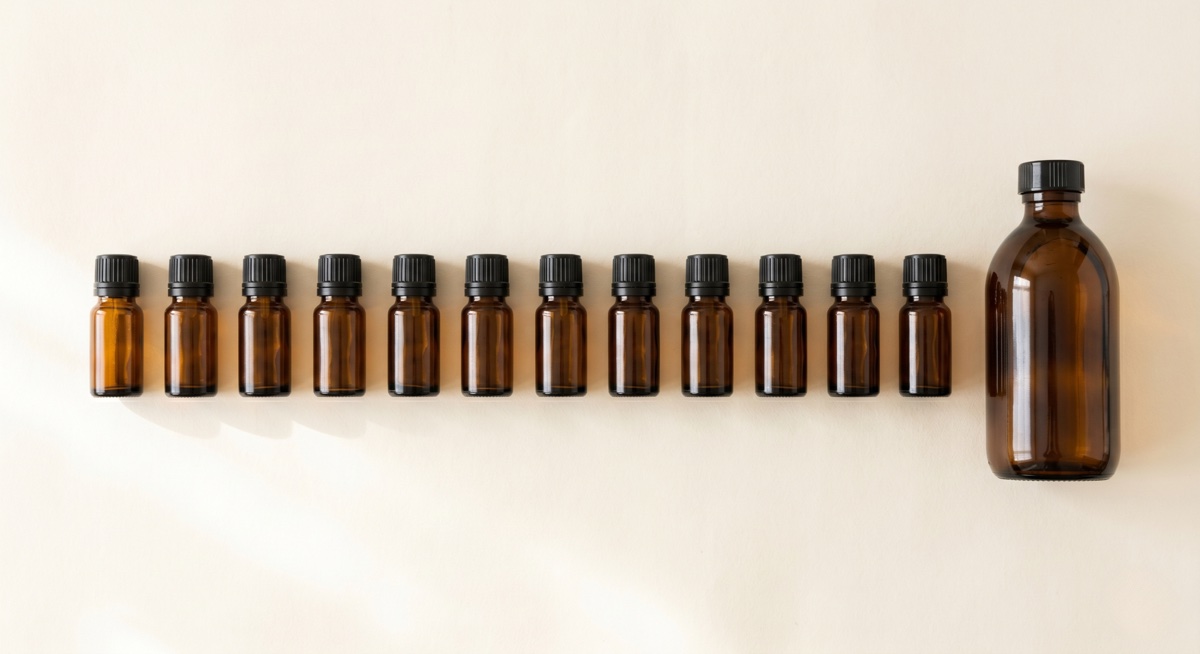
- A set of 12 × 10ml fragrance testers covering oud, sandalwood, light musk, fresh citrus, and a few mid-range profiles suitable for showrooms and wellness spaces
- One 500ml bottle of her chosen fragrance to run in her own machine at her test site
The tester set let her shortlist scents by smell before any real money was committed. The 500ml bottle gave her real-world data — how strong the diffusion was at different machine settings, how long it lasted in the space, and whether her clients responded positively.
For scent selection guidance on the mosque and Muslim market specifically, we recommended leading with oud-based profiles. Oud — derived from agarwood — carries deep cultural and religious significance across the Middle East and Southeast Asia. It’s not a trend in this market; it’s an expectation. Sandalwood works well paired with oud, or standalone for spaces that want warmth without the intensity. For showrooms and spas, we recommended a separate set of lighter profiles — bergamot, clean linen, light white tea — to keep her product range versatile.
For anyone going through the sample selection process for the first time, we have a guide on how to order fragrance oil samples that covers how to evaluate what you receive and what to look for in a performance test.
Why Concentration Is the Variable Most People Miss
This is worth its own section because it explains most of the “can’t smell anything” complaints we hear.
Commercial scenting — whether for a spa, a mosque, a retail showroom, or a rental service — operates in spaces that are fundamentally different from a home environment. The air volume is larger, the ventilation is stronger, and there are more people generating competing olfactory inputs. An oil that smells pleasant in a test bottle will not necessarily perform in a 200 m² space with an HVAC system running.
High-concentration fragrance oil is not a premium option — it’s the correct specification for commercial use. The same way a commercial kitchen uses different equipment than a home kitchen, a commercial scenting setup needs oil formulated for that environment. We covered the broader question of what makes fragrance oil suitable for different applications in Fragrance Oil vs Essential Oil.
The Outcome
She started with the tester set and one 500ml bottle. Low financial commitment, real-world data, no pressure to over-order before the business model was proven.
The field test confirmed the concentration difference — the high-concentration oil performed noticeably better in the mosque space than what she’d been using. Her clients noticed. That’s the point where a scent rental business stops being a hypothesis and starts being a product.
She’s now testing across two sites and selecting her core scent lineup ahead of a wider rollout. It’s a solid, low-risk start — which is exactly what the first phase of this kind of business should look like.
Thinking of Starting a Scent Business?
Whether you’re building a scent rental business, supplying commercial spaces, or sourcing fragrance oils for a specific market, the variables that matter most are concentration, scent selection, and having a supplier who helps you figure out what works before asking you to commit to large quantities.
We work with operators at every stage — from a first tester set through to regular large-volume supply with custom labelling. If you have a target market in mind and want scent recommendations before placing an order, send us the details and we’ll put together options within 48 hours.