
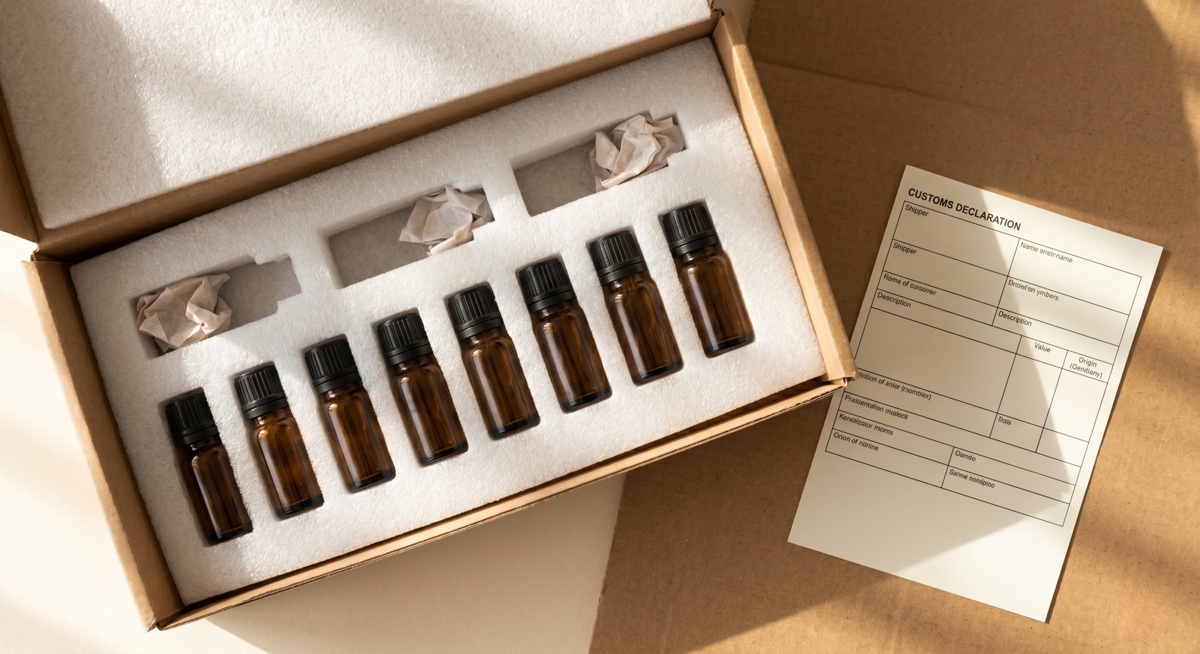
Not long ago, we shipped a set of fragrance samples to a client in Oman. Standard request, standard process — or so it seemed. The samples left our warehouse on time. Then the silence started. Days passed with no delivery update. Then two weeks. Then three. The tracking showed the shipment was somewhere in the network, moving in no particular direction.
What followed was a month of persistent follow-up: requesting the exact carrier name from the forwarder, going directly to that carrier’s official customer service, escalating at every stage, and refusing to let the shipment disappear into the logistics void. The samples arrived safely in the end — but only because we didn’t stop pushing.
That experience made something clear: when you’re shipping samples from China to a buyer, the freight forwarder you choose is not a background detail. It’s part of the service you’re delivering.
Why Sample Shipping from China Is More Complex Than It Looks
A bulk production order moves through well-established commercial freight lanes. Samples are different. They’re smaller, they’re time-sensitive, and they often get lower priority from carriers because the commercial value on paper is low. A carton of 10 fragrance oil samples doesn’t look important on a manifest — but for the buyer waiting to evaluate them before placing a real order, it’s the entire deal.
Fragrance products add another layer of complexity. Most fragrance oils are classified as flammable liquids under IATA and IMDG regulations, which means they face restrictions on certain air freight lanes and require proper documentation — safety data sheets, correct UN numbers, declared concentrations. A freight forwarder who doesn’t routinely handle these categories will either reject the shipment, mislabel it, or route it in a way that creates delays at customs. We covered the broader picture of import costs and hidden risks in Total Landed Cost: 5 Hidden Risks.
Destinations That Require Extra Attention
Not all shipping lanes are equal. Western Europe, the US, and parts of East Asia have well-developed courier infrastructure with reliable last-mile networks. The Middle East, parts of Africa, and certain Southeast Asian markets are different — not impossible, but they require a forwarder with specific experience in that destination.
Countries like Oman, Saudi Arabia, Qatar, and the UAE have customs processes that are stricter around chemical products, including fragrances. Documentation needs to be exact. Commercial invoices need to match declared contents precisely. Some products require additional certificates — MSDS, country of origin, sometimes halal certification for certain categories. A forwarder who’s never shipped to these markets will find out what they don’t know at the worst possible moment.
Before using a new forwarder for a destination you haven’t shipped to before, ask directly: how many shipments have you handled to this country in the past six months, and what specific documentation do you prepare? The answer will tell you everything.
What to Do When a Shipment Gets Stuck
Even a good forwarder will occasionally hit a problem. The difference between a one-week delay and a one-month delay usually comes down to how quickly you catch it and how hard you push.
The most important first step is getting the actual carrier name and tracking number — not just the forwarder’s reference number. Many smaller forwarders consolidate shipments under their own tracking, which means you can’t independently verify where the parcel is. As soon as a shipment goes quiet, request the master airway bill or the final carrier tracking number, and go directly to that carrier’s official customer service.
Don’t rely on the forwarder alone to chase their own network. They have hundreds of shipments to manage. Your sample is one line item. Call the carrier directly, give the tracking number, and ask specifically what’s causing the hold and what document or action would release it.
This is exactly what resolved the Oman shipment. The forwarder had stopped providing updates. We requested the carrier’s tracking reference, contacted them directly through their official channel, identified the specific point of failure, and escalated until it moved. Persistent follow-up — across multiple parties, consistently — is what got the samples delivered.
Shipping Samples from China: How to Evaluate a Forwarder Before You Use Them
The time to vet a freight forwarder is before you ship, not after. A few questions worth asking:
- Do they have experience with your destination country specifically, and how frequently do they ship there?
- How do they handle hazardous or restricted goods classifications, including flammable liquids?
- What documentation do they prepare as standard, and what do they require from the shipper?
- Do they provide the final-mile carrier’s tracking number, or only their own reference?
- Who is the direct contact if a shipment goes wrong — and is that person accessible by phone or message, not just email?
That last point matters more than people expect. A forwarder with a responsive single point of contact who actually picks up the phone is worth more than a cheaper option where problems disappear into a support ticket queue.
Why the Supplier’s Salesperson Matters as Much as the Forwarder
The buyer rarely has visibility into who the forwarder is or what’s happening inside the shipping network. What they see is whether their contact at the supplier is on top of it.
A salesperson who hands over a tracking link and goes quiet is a problem. A salesperson who proactively flags delays, provides carrier contact details, and keeps following up until the package arrives is the reason buyers come back and place larger orders.
When you’re evaluating a fragrance supplier in China, ask how they handle shipping problems — not as a hypothetical, but as a direct question. How they answer tells you whether they’ll be a partner or a handoff.
For buyers in the early stages of sourcing, our guide on how to order fragrance oil samples covers the full process from requesting samples through to evaluating what you receive. Knowing what to ask about shipping before you place a sample request will save you the month we spent tracking down that Oman shipment.
What We Do Differently
Since that experience, we’ve tightened our forwarder vetting process specifically for Middle East destinations and other markets with complex customs environments. We maintain relationships with carriers who have documented experience in those lanes, we prepare documentation packages before the shipment leaves, and we follow up with carriers directly if a shipment goes quiet — not just with the forwarder.
If you’re sourcing fragrance products and want to understand how your samples will be shipped before you request them, ask us directly. It’s a question worth asking any supplier you’re considering.