
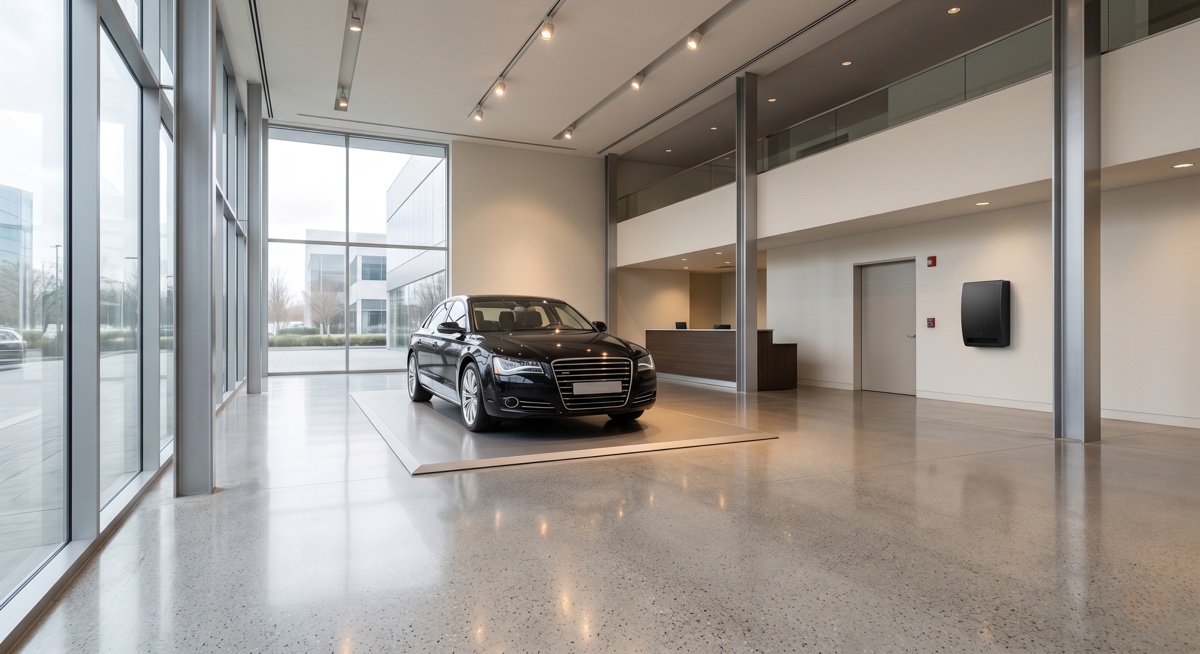
Scent marketing for car dealerships is one of the most underutilized tools in automotive retail. Premium and luxury car brands have understood for years that the buying decision isn’t purely rational — it’s experiential. The ambient scent that greets a customer as they walk onto the showroom floor shapes their perception of quality before a single word is exchanged with a salesperson. Most dealers invest heavily in lighting, display surfaces, and staff training. Very few think about what the space smells like.
Why Car Dealerships Invest in Scent Marketing
The automotive showroom has a scent problem most operators don’t acknowledge. The natural background of a dealership — rubber, cleaning products, mechanical odors drifting from the service bay — doesn’t reinforce the premium image the vehicles themselves project. Scent marketing for car dealerships addresses this directly: replace uncontrolled background smell with something intentional that aligns with the brand.
Beyond masking, research consistently shows that ambient scent affects time perception and purchase behavior. Customers in a comfortable, pleasant-smelling environment are more likely to engage in extended conversations with sales staff — which is where automotive deals are made. We covered the commercial data in Scent Marketing ROI: ambient scent measurably increases dwell time and brand recall across retail environments. A showroom is no different.
According to Wikipedia’s overview of scent marketing, olfactory cues are processed faster than any other sensory input — making the first few seconds inside your showroom door the most important moment your fragrance program needs to address.
Scent Marketing for Car Dealerships: Zone-by-Zone
Not every area of a dealership needs the same treatment.
Showroom Floor The primary brand impression space. Fragrance here should reflect the vehicle brand’s identity — not generically pleasant, but specifically aligned. Luxury segment dealers (German, Japanese, Scandinavian) work well with clean, refined profiles: fresh linen, light cedar, or cool ozonic notes. The goal is for the space to register as premium without the customer consciously noticing a scent.
Customer Lounge and Waiting Area Customers waiting for paperwork or a test drive spend 20–40 minutes here. A warmer, more relaxed profile works better — light woody, soft amber, or clean musk. This is where scent has the clearest measurable impact on perceived service quality and patience.
Sales Offices and Consultation Rooms Enclosed spaces amplify diffusion, so intensity should be lower. Sandalwood and light vetiver are consistently cited in retail psychology research as promoting trust and relaxed decision-making — exactly what a sales office needs during a deal discussion.
Service Reception The most overlooked zone. Customers dropping off vehicles are often anxious about cost and time. A clean, fresh fragrance — eucalyptus, white tea, light citrus — directly addresses the workshop smell problem while signalling professionalism and control.
What Fragrance Profile Works for a Car Showroom?
The right scent depends on where your brand sits in the market:
Luxury and Premium brands — Sandalwood, cedarwood, light oud, warm leather accords. These reinforce associations of precision, craftsmanship, and exclusivity. Avoid anything fruity or mass-market floral.
Volume and Mass-Market brands — Clean linen, light citrus, fresh aquatic. Approachable and non-polarising for a broader demographic.
EV and Tech-Forward brands — Ozonic, clean green, or neutral musk. These align with the clean-future positioning most electric vehicle brands are building, without the heavy or old-world associations of wood and leather.
One rule consistent across all segments: keep it unisex. Automotive buyers are split across gender, and a showroom fragrance that skews too strongly in either direction will feel misaligned for a significant portion of your floor traffic.
Choosing the Right Diffuser for a Dealership
Showroom floor area typically runs 500–2,000 m² with high ceilings. Standalone desktop diffusers won’t deliver consistent coverage at this scale. Two approaches work:
- HVAC-connected scent systems distribute fragrance through existing air handling infrastructure, providing even coverage without visible hardware on the floor. Ideal for flagship locations with full-time facility management.
- Cold-air diffusers positioned at entry zones are the most cost-effective starting point. Placed near main entrances, they create a scent impression as customers arrive without requiring any infrastructure modification.
We covered the technical differences in Cold Air Diffuser vs Ultrasonic. For showroom use, cold-air technology is the right choice: it runs silently during sales conversations, works with concentrated fragrance oils, and produces no visible vapor that would look out of place in a clinical, high-spec showroom environment.
Common Mistakes in Dealership Scent Marketing
Choosing a generic luxury scent. Many dealers default to something that smells like a hotel lobby. If your brand is a volume seller, that creates a cognitive mismatch. The fragrance should match your brand tier, not a borrowed “expensive” category.
Ignoring the service bay connection. In many dealerships, service and showroom share air circulation paths. No ambient fragrance program overcomes active mechanical odors drifting through. Address the air separation first, then layer the scent on top.
Running maximum intensity during busy periods. High foot traffic on a weekend means more body heat and competing inputs. Program your diffuser to run at lower intensity during peak hours, not higher.
One unit for a large open floor. A single diffuser near reception will not scent a 1,000 m² showroom. Plan one unit per 80–100 m² of active floor space as a baseline, and position for airflow rather than for visibility.
Getting Started
The simplest entry point is a single cold-air diffuser at the main customer entrance, running a fragrance profile matched to your brand tier. Run it for four weeks, gather feedback from your front-desk and sales team, then decide whether to extend to the lounge and consultation rooms.
For dealership groups with multiple sites, standardising a house scent across locations builds consistent brand recall — customers who visit more than one branch encounter the same sensory identity, which reinforces the brand rather than creating confusion.
If you’d like sample options for your showroom — we’ll shortlist two or three fragrance profiles based on your brand and floor plan, and arrange samples within 48 hours. Send us your requirements here.