

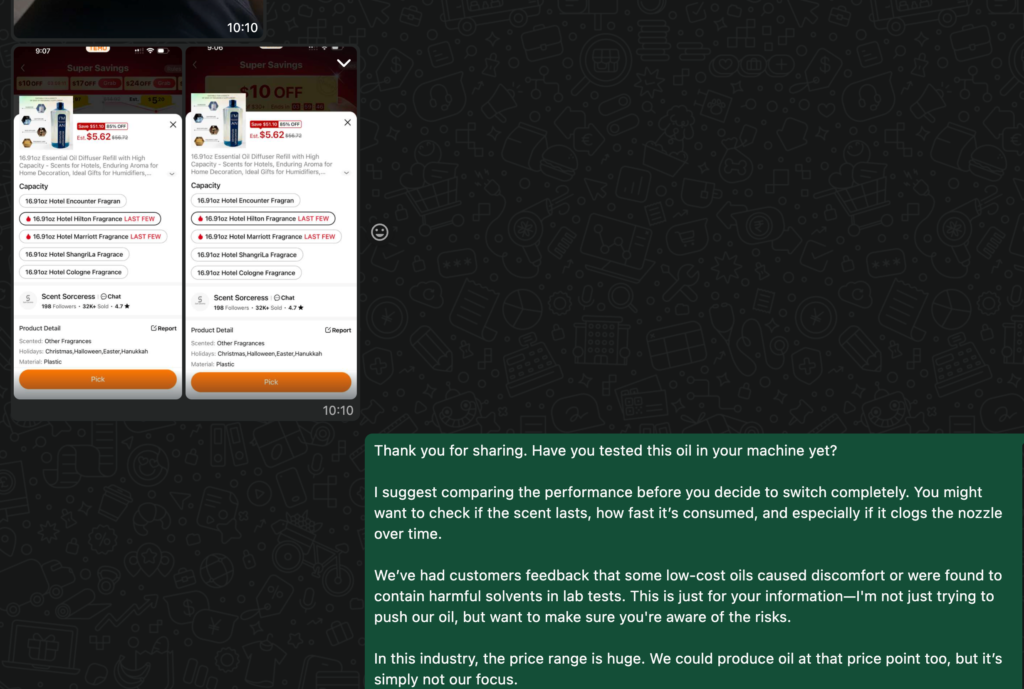
This week(today), one customer from the US sent me a screenshot. A diffuser oil on Temu or Amazon — $5 for 500ml, decent reviews, looks identical to what we sell. The question is always the same: “Why is yours so different?”
It’s a fair question. Cheap fragrance oil exists, and plenty of people use it. The problem isn’t that it smells bad on day one. The problem is what you can’t see, can’t predict, and can’t test without a lab — and by the time you find out, the damage is already done.
What “Cheap” Actually Means in Fragrance Oil
Low price doesn’t come from thin margins. It comes from substitutions: lower-grade carrier oils, undisclosed synthetic solvents, skipped safety testing, no batch consistency standards. The manufacturer isn’t losing money at $5 — they’re just not paying for the things that don’t show up on a product listing.
This matters more than most buyers realise, because fragrance oil doesn’t stay in the bottle. It goes into the air. Into every breath taken in that room. By you, your children, your pets, and anyone else present.
5 Things Cheap Fragrance Oil Costs You (That Don’t Show on the Label)
1. Rancidity — The Smell That Tells You It’s Too Late
Low-quality carrier oils oxidise. When they do, the oil doesn’t just lose its scent — it smells actively unpleasant. For commercial buyers, this means wasted stock. For home users, it means diffusing rancid compounds into a closed room and not knowing why it smells off.
Shelf life matters. A properly formulated fragrance oil with a stable carrier can last 12–24 months. Cheap alternatives often degrade in 3–6 months, especially in warm climates.
2. Clogged Diffusers — When the Savings Disappear Overnight
Impure oils contain particulates, waxes, and residue that nebulising diffusers aren’t designed to handle. Cold-air diffusers and HVAC systems are especially vulnerable. One blocked nozzle doesn’t just mean a repair bill — it often voids the warranty. We’ve had customers come to us after spending more on diffuser repairs than they saved on six months of cheap oil.
3. Unknown Ingredients — Especially Dangerous Around Pets and Pregnant Women
This is the one most buyers don’t think about until it’s personal.
Many cheap fragrance oils contain undisclosed solvents — compounds that are legal to import but not safe for continuous inhalation. There is no regulation requiring the seller to list every ingredient. Without an IFRA-compliant safety assessment and a proper Material Safety Data Sheet (MSDS), you simply don’t know what you’re breathing.
For households with cats, dogs, birds, or small animals, this is serious. Many essential oil compounds and synthetic solvents are toxic to pets at concentrations that are imperceptible to humans. For pregnant women, the concern extends to foetal exposure — and no $5 oil comes with a study proving it’s safe at that level.
We’re not raising this to alarm you. We’re raising it because no one else is.
4. Batch Inconsistency — The Scent That’s Never Quite the Same
Cheap suppliers don’t maintain formula consistency across production runs. The oil you loved in month one may smell noticeably different in month three. For hotels and retail environments building a scent identity, this is a slow-motion brand problem. Scent memory is powerful — but only when the scent is consistent.
5. No Support When Something Goes Wrong
When a $5 Temu product causes a problem, there is no one to call. No formulation data to share with a vet. No batch records to check. No account manager. You’re on your own with a screenshot of a listing that may no longer exist.
We Could Make Cheap Oil. We Choose Not To.
At the price point some suppliers operate at, the margin isn’t in the product — it’s in the volume and the lack of accountability. We’ve been in this industry long enough to know exactly what corners get cut to hit $5/500ml. We could produce at that price. We’ve chosen not to, because we’re building something that lasts longer than a single transaction.
Our oils have been sold safely for over a decade. That’s not a marketing claim — it’s a business model. Repeat customers, long-term accounts, and referrals are only possible when nothing goes wrong.
How to Actually Evaluate a Fragrance Oil Supplier
Before you buy from anyone — including us — ask these questions:
- Can you provide an SDS (Safety Data Sheet) for this oil? If the answer is no, walk away.
- Is the formulation IFRA-assessed? This sets the international safety standard for fragrance compounds.
- What is the carrier oil base, and what is the concentration? Vague answers here mean the supplier doesn’t know — or doesn’t want you to know.
- Can I order the same batch formula for reorders? Consistency is a production discipline, not a given.
- What happens if there’s a quality issue? A real supplier has a process. A platform listing has a returns window.
The Real Cost Comparison
Let’s be direct. If our oil is three times the price, but:
- You use 40% less per session due to higher concentration
- Your diffuser runs clean for years instead of months
- You have zero incidents, complaints, or vet bills
…then the per-use cost is comparable — and the risk profile is completely different. For commercial buyers running hotel properties or retail spaces, a single guest complaint about scent quality costs more than a year’s supply of better oil.
If you’re sourcing fragrance oil for a business, a wellness space, or a home with people and animals you care about — we’re happy to match you with the right formula and arrange samples before you commit. Get in touch and we’ll respond within 24 hours.