
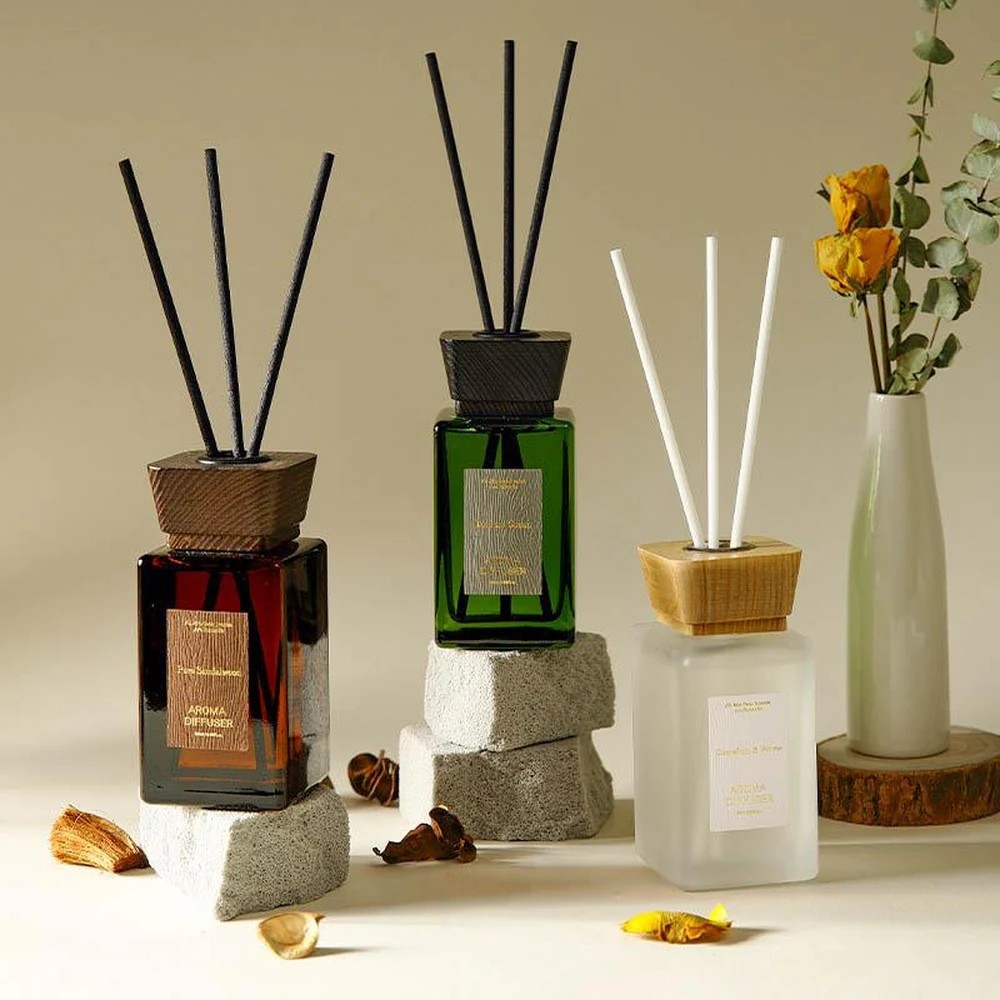
A reed diffuser refill is only a good buy if it works in the diffuser you already have. The scent name on the bottle tells you almost nothing: the liquid has to match the original fragrance, move through the same reeds, and pour cleanly into the same vessel. So start with the vessel, not the catalogue. Ask for the refill liquid by its fragrance reference, test it in your vessel with your reeds, check the bottle pours without drips, and request safety documents for your exact product and market. Then set your reorder point before the bottle runs dry — a refill programme only works when the next bottle arrives before the last one is empty. The checklist below walks through each step, so the refill you order is the refill your customers can actually use.
This guide is for retail brands, distributors and hospitality buyers who already sell or use reed diffusers and want to add refills. It is not about choosing a first reed diffuser — that is a different decision — and it does not cover electric scent diffusers, which need a separate compatibility check.
Why refills go wrong
A refill looks like the simplest product in the range — a bottle of liquid for a diffuser already on the shelf. That is exactly why it goes wrong: buyers treat it as a commodity and skip the checks they would never skip on a finished diffuser.
Three mismatches cause almost every refill problem. The first is scent: the refill smells right in the bottle but different in the room, because it is a similar fragrance, not the same one. The second is wicking: the liquid does not travel through the reeds the way the original liquid did, so the scent fades early or never reaches the room. The third is the pour: the refill bottle does not fit the vessel neck, drips down the side, or has a cap that leaks in transit.
Is the refill the same scent as the original?
Start here, because this is the mistake that costs the most. A familiar scent name tells you little about how the liquid will perform. Two suppliers can both sell a liquid called “white tea” and produce two different smells in the room — and even one supplier can change the result if the refill is blended from a different fragrance oil than the original diffuser.
Ask for a quote for ready-to-use refill liquid if your customers will pour it straight into a diffuser, and ask for the refill by fragrance reference, not by scent name. Give the supplier the fragrance reference or scent profile of the original diffuser and ask them to confirm, in writing, that the refill liquid uses the same fragrance oil — the same reference code, not a close match. If you are developing the blend yourself, request fragrance oil and specify that it is for a passive reed diffuser, so the supplier formulates for reeds rather than for a burner or an electric device. And quote the two as separate items: a fragrance concentrate and a finished refill are different products, with different documents and different handling.
Use fresh reeds with a new refill. Reeds absorb the liquid they sit in, so reeds that have been running in one fragrance carry that scent into the next bottle. If the refill is sold with replacement reeds, include them in the test; if it is not, order fresh reeds with the refill and say so in your brief. Topping up an old bottle with a different liquid, or reusing reeds across fragrances, is the fastest way to get a scent nobody recognises.
Then compare the refill against the original side by side. Set up the original diffuser and the refilled vessel in the same room, with the same fill level and the same number of reeds, and smell both at the same checkpoints. If the refill is not the same scent in the room — not in the bottle, in the room — it is not the right refill, however good the name sounds.
Will it pour cleanly into your bottle?
A refill that cannot be poured cleanly is a refill your customer will spill, and a spill is a stain on a table, a ruined label, or a bottle that arrives half empty. Check the pour before you order, not after the first customer complains.
Try the bottle with the actual diffuser opening. Can you pour the intended amount without drips? The refill bottle needs a mouth or spout that fits the vessel neck — a wide-mouthed bottle over a narrow-necked vessel is a spill waiting to happen, and a bottle with no pouring spout at all is worse. Check how the cap opens and closes, whether the seal holds when the bottle is turned on its side, and whether the bottle feels secure when handled repeatedly. Keep a short written note of anything that spills, catches or closes poorly, and send that note to the supplier with your sample feedback.
The pour is also a packaging question. Tell the supplier whether units will travel together in master cartons or be shipped one at a time, and ask for the refill dimensions, filled weight, packaging dimensions and the number of units per master carton. Make sure that the refill is described accurately for customs and that any dangerous goods classification is correct for the selected shipping method — a liquid refill is not classified the same way as a finished diffuser, and the classification depends on the product and how it travels. Test the retail carton or gift packaging with the refill bottle inside before you approve it: the bottle, the cap and any replacement reeds all have to fit, and the carton has to survive the journey without the bottle moving around inside it.
How do you test a refill before you order?
The most useful sample recreates the intended refill experience: the proposed liquid, in the intended vessel, with the intended reeds.
Send the supplier the original vessel size and neck opening, the reed material and dimensions, and the fragrance reference or scent profile. Ask for the proposed liquid in the intended vessel with the intended reeds. If the refill is sold with replacement reeds, include them in the test — the reeds are part of the product, not an accessory.
Compare samples side by side using the same fill level, number of reeds and room conditions. Record scent intensity after setup and at agreed checkpoints, along with the refill level and the point at which the liquid stops moving through the reeds. Keep any sample that performs inconsistently out of your main shortlist, even when the scent profile is right.
If you also sell electric scent diffusers, send the device model and request a separate compatibility check. A refill liquid made for reeds does not belong in an electric device unless the supplier confirms it, and that confirmation should be in writing.
What documents should you ask for?
A refill is a chemical product, and the documents that cover it are the documents for that exact product — not for a similar one, and not for the finished diffuser it goes into.
Give the supplier your destination market and intended use. Ask which safety, labelling and transport rules apply to the supplied product, and request safety data sheets and compliance documents for that exact product. Check that the certificate names the product, the fragrance and the market rather than only a similar product. Make sure the certificate was produced by an accredited laboratory or certification body. See IFRA’s guidance on certificates for what a valid certificate should contain.
On IFRA specifically: the current IFRA Standards are the 51st Amendment, notified in June 2023. The 52nd Amendment is expected to be formally notified in January 2027, so certificates issued now should still reference the 51st Amendment. If a supplier’s certificate names a different amendment, or no amendment at all, ask them to explain before you order.
One more check that buyers skip: ask the supplier to confirm the documents match the refill you are actually buying — same fragrance reference, same concentration, same bottle size. A certificate for the supplier’s 200 ml reed diffuser does not automatically cover the 120 ml refill liquid, even when the scent name is the same.
How long does a bottle last — and when do you reorder?
This is the question that decides whether refills become repeat business or a one-off sale, and it has no single answer. How long a bottle lasts depends on the vessel size, the number of reeds, the room size, the ventilation and the temperature. A refill in a small, still bedroom lasts longer than the same refill in a large room with an extractor fan running all day. So do not accept a single number of days as a promise, and do not print one on your own packaging unless you have tested it in the conditions your customers actually use.
What you can do is set a reorder point and stick to it. Decide the level at which you order the next bottle — for most buyers, when the bottle is about a quarter full — and put that check on a regular schedule, for example when the room is cleaned or when stock is counted. The point is to order while there is still liquid in the diffuser, not after it has run dry.
For regular supply, ask the supplier about a standing order or subscription arrangement: the same fragrance reference, shipped on a fixed schedule, in the quantity your sales suggest. The arrangement only works if three things are fixed in writing — the fragrance reference, so the scent never changes between shipments; the schedule, so the next bottle arrives before the last one runs out; and the quantity, based on how many diffusers you actually have in use rather than a guess. Ask the supplier what standing-order terms they offer, including the minimum quantity per shipment, and confirm whether replacement reeds are included in each shipment or ordered separately.
What to send for a sample or quote
Send the supplier this brief, and you will get a useful quote back instead of a round of follow-up questions:
- Destination market and sales channel.
- Existing diffuser vessel and reed specifications.
- Fragrance reference or scent profile.
- Intended refill volume and packaging.
- Safety and labelling requirements for the destination market.
- How often you expect to reorder, and whether you want a standing supply arrangement.
Compare reed diffuser bottle and packaging options or explore fragrance oil sample directions. If you already have a vessel or refill brief, send Scentvita your requirements for a sample or quote.