
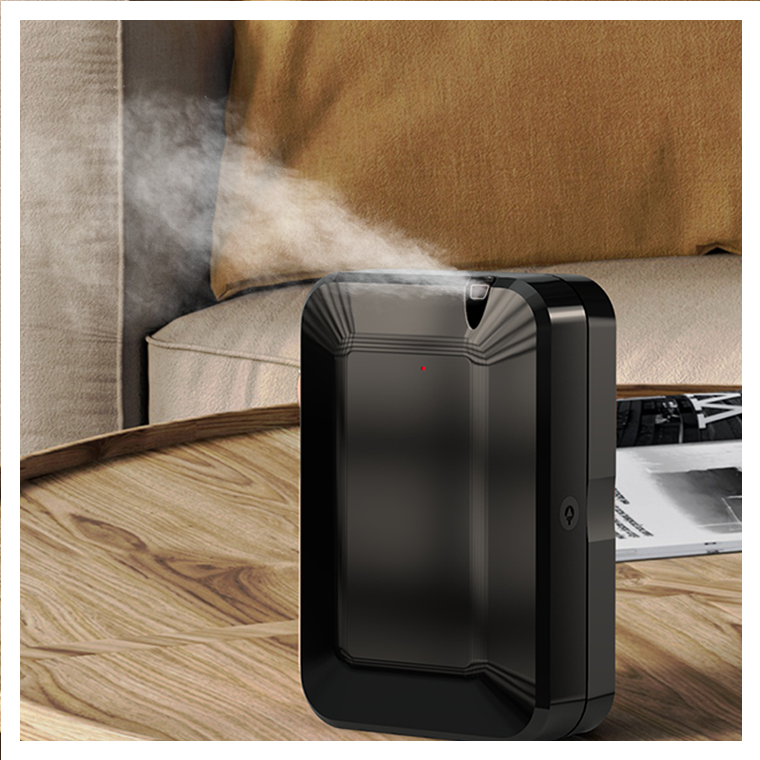
A commercial washroom is the hardest small space to keep smelling clean — and the easiest to get wrong. The right setup is a battery-powered cold-air diffuser with a fresh, neutral scent, one unit per washroom in most cases, and a lockable unit if the space is public. That is the short answer. The rest of this guide explains how to choose the machine, which scent to use, how many units you need, and what to ask your supplier before you order — so the washroom still smells clean at 4pm, not just at 8am after the morning clean.
This guide is for cleaning companies, facility managers, and hotel or office operators who look after washrooms. It is not about scenting a lobby or a retail store — those are bigger spaces with different rules — and it does not cover connecting scent to a central HVAC system, which is a separate decision for large spaces.
Why washrooms are a different problem
A cleaner finishes a washroom at 7am. At 8am it smells fresh. By noon, the smell is gone — and the first thing a visitor notices is not the clean floor, it is the drain. That is the moment cleaning companies get judged on, and it happens between cleans, when nobody from the cleaning team is in the room.
Washrooms break the normal rules of scenting in four ways. First, they are small and enclosed, so scent builds up fast — a machine set for a lobby will be overpowering in a washroom. Second, most washrooms have an extractor fan running all day, and a fan exhausts fragrance just as fast as it exhausts steam. Third, most washrooms have no power socket, or the only socket is in an awkward place. Fourth, anything small and portable in a public washroom can be picked up and taken — one buyer asked us specifically for a battery unit with a lock for washrooms, because unsecured units kept disappearing.
None of this means washrooms cannot be scented well. It means the machine and the scent have to be chosen for a washroom, not copied from a lobby setup.
Battery or plug-in?
Start with the socket question, because it decides everything else.
If the washroom has no socket — and most do not — the answer is a battery-powered unit. Battery units are made for exactly this situation: they sit on a shelf or a counter, run on their own power, and can be moved when the washroom is cleaned. If the washroom does have a socket in a sensible place, a plug-in unit works and you never think about batteries — but check first that the socket is not behind a door, above a sink, or somewhere a cleaner will unplug it to charge a phone.
Many operators end up with both. One building-services customer scenting 42 washrooms and 3 lobbies ordered 48 battery units and 6 large plug-in units: battery machines for the washrooms, large plug-in machines for the lobbies. The washrooms have no sockets and need machines that move with the cleaning round; the lobbies have power and run all day. Match the power source to the space, not the other way round.
Two things to check before you commit to battery. First, ask the supplier for the runtime at the setting you will actually use — not the maximum, and not a lab figure. A unit that runs for weeks on its lowest setting may run for days on the setting a busy washroom needs. Second, check whether batteries are included. Some battery models ship without batteries, which is a small detail that becomes annoying when you are fitting out 40 washrooms at once.
Which machine for which washroom
Do not buy on the brand name or the photo. Buy on two numbers: the coverage area and the oil capacity. Coverage tells you whether one unit is enough for the room; capacity tells you how often someone has to refill it.
For a single small washroom, a compact battery unit is usually enough. Our smallest battery model covers around 300 sq ft (about 28 sq m) with a 45 ml bottle and runs on 3 AA batteries — that fits a single washroom or a small restroom. A mid-size battery unit covers around 1,500 sq ft (about 140 sq m) with a 250–400 ml bottle, which covers a larger washroom area or several stalls. The largest battery unit covers around 2,000 sq ft (about 186 sq m) with a 500 ml bottle and runs on 4 D batteries — that is the one to use when a washroom area is big, or when you want fewer refills across many rooms.
If there is a socket, the small plug-in models cover 300–900 sq ft (about 28–84 sq m) with 100–150 ml bottles, which is enough for most single washrooms. For lobbies and large public areas, the commercial plug-in units cover 4,500–6,500 sq ft (about 420–600 sq m) with 500–1,000 ml bottles and run all day.
Treat the rated coverage as a maximum for still air. A washroom with a strong extractor fan is not still air — the fan pulls scented air out as fast as the machine puts it in, so you may need a higher setting or a larger unit than the floor area alone suggests. The safest way to size a washroom is to trial one unit in one washroom for a week before you order for all of them. If one unit holds the scent through a full day, the sizing is right. If the scent is gone by noon, step up a size or raise the setting — do not just order more units.
One more thing: ask whether the unit can be locked or fixed in place. In a public washroom, a small machine on an open shelf is easy to move, unplug, or take. A lockable unit, a wall bracket, or simply placing the machine out of easy reach solves most of it — but confirm with the supplier what fixing options exist for the model you choose, because not every model has them.
Which scent — and what scent cannot fix
For a washroom, pick a fresh, clean, neutral scent family: white tea, linen, light citrus, or a soft clean musk. The scent should read as “this room is clean,” not as “someone sprayed air freshener.” Heavy sweet, heavy floral, or strong woody scents feel wrong in a small space — and in a washroom, a strong scent reads as covering something up, which is the opposite of what you want.
Sample before you commit. The right scent for a washroom is a judgment call, and it depends on the building, the users, and what the cleaning products already smell like. Order scent samples first, try two or three in one washroom for a few days each, and let the people who clean the room tell you which one works. One buyer in Singapore needed a battery unit to cover about 150 sq m and spent the sample stage on scent selection before ordering machines — that is the right order. Machines are easy to swap; a scent the whole building dislikes is not.
And be honest about what scent cannot do. Scent does not replace cleaning, and it does not fix a plumbing problem. If a washroom smells of drains, fix the drain first — no diffuser will cover that, and a strong scent on top of a drain smell is worse than no scent at all. Scent is the last step, after the room is actually clean. It keeps the room smelling clean between cleans; it is not a substitute for the clean itself.
What to ask your supplier before you order
Do not order on the basis of a photo and a coverage number. Ask these five questions first, and get the answers in writing:
- Runtime. How long does the battery last at the output setting I will actually use in a washroom, and how often will my team need to change batteries across all my washrooms?
- Fixing. Can this model be locked or wall-mounted, or is there a bracket? What do you recommend for a public washroom?
- Refills. How many millilitres is the bottle, how long does it last at a normal setting (oil consumption math), and how do I order refills — do they come in the same scent, and is there a minimum order?
- Samples. Can I get scent samples before I order machines, and can I trial one machine in one washroom first?
- Support. If a unit stops working, what happens — do you repair it, replace it, or send parts? How long does that take?
If the supplier cannot answer the runtime question with a number for your setting, treat that as a warning sign. And if you are ordering for many washrooms at once, ask for one trial unit first. A supplier who is confident in the product will say yes.
What usually goes wrong
Four things go wrong with washroom scenting, and all four are avoidable.
The scent is too strong. This is the most common complaint, and it happens when a lobby-sized machine or a high setting is used in a small room. Fix it by turning the output down or stepping down a size — do not solve it by switching the machine off, because then you are back to no scent at all.
The scent disappears by midday. Usually the extractor fan is the cause, or the machine is set too low. Fix it by raising the setting one step, or by using a larger unit. If the fan is very strong, ask the supplier whether a higher-output model is a better fit for that room.
The unit goes missing or gets unplugged. Fix it with a lockable unit, a bracket, or a less accessible spot — and brief the cleaning team that the machine stays where it is. A unit that moves around the building is a unit nobody maintains.
The batteries die and nobody notices. Fix it by putting battery changes on the cleaning schedule, not on memory. When the room is cleaned, the battery gets checked. If your team manages dozens of washrooms, pick one battery type across all units so the team only stocks one kind.
What to do next
Start with one washroom, not forty. Pick the busiest washroom you manage, request scent samples and one trial machine, and run it for a week. If it holds the scent through a full day and the cleaning team is happy with the maintenance, you have your setup — then roll it out to the rest.
To request samples, tell us how many washrooms you have, their approximate sizes, and whether there is a power socket in each. We will recommend a machine, send scent samples, and confirm the refill schedule before you order. You can reach us through the contact form on this site, by email at [email protected], or on WhatsApp at +86 181 6354 3373.